Showing posts with label California. Show all posts

Tuesday, March 09, 2010

CA Sen. Roy Ashburn: "I'm Gay" – And Stand By My Anti-Gay Votes


COMING OUT
I am gay. Those are the words that have been so difficult for me for so long. But I am gay, but it is something that is personal and I don't believe — I felt with my heart being gay … did not effect, would not effect how I do my job. What happened through my own actions the other night changed all that.

ON HIS VOTING RECORD
My votes reflect the wishes of the people in my district. And I have always felt tha tmy faith and allegiance was to the people there in the district, my constituents. So as each of these individual measure came before the legislature, I cast "no" votes. … I cherish the fact that we have a remarkable system of government, and that system of government provides for representatives elected by the people to go to the legislative bodies, whether it be Washington D.C. or Sacramento, and cast votes on behalf of the people, not my own point of view, not my own internal conflict, certainly to use my best judgment, but to vote as my constituents would have me vote. There's never been a doubt in my mind on the position of the vast majority of the people in my district, the 18th senatorial district, on these different issues. I voted as I felt I should on behalf of the people who elected me.

Tuesday, March 02, 2010

Paso Robles - The Not So Secret Spot... Anymore

The Daily News ran a wonderfully rich and vibrant story on one of my wife and I's favorite getaways, Paso Robles. There is an "E-Edition" of the Daily News to subscribe to if you are not in the Los Angela's areas. Here it is:


PASO ROBLES - The February issue of a respected wine industry trade publication gives only one of the world's wines both a rarefied 98 score and the top spot in the "highly recommended" section.

Near perfection came from Saxum, a well-regarded but obscure winery in Paso Robles, a one-time California cow town becoming a superior wine-producing region known by few non-aficionados outside the state.
 
Located on California's Central Coast, the Paso Robles viticultural area's consistent quality and relatively moderate land prices have combined for phenomenal growth.

In fewer than 20 years, the number of wineries has grown from 30 to 250 and counting, plus at least 600 hopefuls making boutique bottles at custom crush co-ops to hawk at restaurants and local wine bars.

Esteemed reviewer Robert Parker has said the region of rolling, oak-studded hills holds California's greatest potential. Winemakers swear by a climate and limestone-infused soils that mimic the southern Rhone region of France.

Most are family operations that make fewer than 5,000 cases a year, which make them impossible for distributors seeking consistent availability to market nationally. Saxum bottles fewer than 3,000 cases and its wine club has a wait list. (The winery's 2007 James Berryhill that earned Wine Spectator's 98 - and 100 from Parker in October - sells for $67, compared with $375 for a French 98 in the same issue.)

"The reason people don't know Paso is because they don't see it in the marketplace. Maybe 20 are distributed now; it would help the region to have more," said Deborah Baldwin, co-owner of Justin Wine Co., founded in 1981 when there were seven wineries in the region.
Hugging the coast midway between San Francisco and Los Angeles, the 666,618 acres of the Paso Robles Viticulture Area is California's largest - three times the size of Napa. It comprises just more than half of the Central Coast wine region that stretches 250 miles from San Francisco to Santa Barbara.

Grapes have grown there since the Mission padres settled in the late 1700s. In the 1980s, the flat and sprawling east side became home to large commercial wineries such as Eberle and Meridian and later Gallo, Robert Mondavi and Kendall-Jackson farming 25,000 acres. But the cooler west side, where 5,000 acres are planted across hilly terrain, is where winemakers are scoring with critics.

With a production of 70,000 cases, Justin has tallied international accolades and become the region's vaunted behemoth and image maker: its 1994 Isosceles, the iconic blend of Cabernet Sauvignon, Cabernet Franc and Merlot, was named "Best Blended Wine in the World" at the London International Wine & Spirit Competition. Wine Spectator named its 1997 Isosceles No. 6 in the world.

There is a wait for Isosceles reserve, but prices range from just more than $60 for Isosceles to $18.50 for the winery's screw top "Orphan" blend of leftover juices from the hand-harvested single vintage.

Justin draws 40,000 visitors a year, many of whom meander the wine trails to discover a new favorite or obscure winemaker. Or, not obscure: Miss America 1957 Marian McKnight owns Carmody McKnight with her husband. Former NFL defensive back Terry Hoage produces 2,100 cases of Rhone-inspired wines nearby.

"We realize we're all in this together," says Justin Baldwin, who believes the success of one increases exposure and recognition for the others.

Paso Robles has half as many wineries as Napa, but like Napa its climate includes coastal breezes and stifling inland valley heat. The wine boom and influx of oenophiles have transformed downtown Paso from an ag town of 18,000 in 1990 to a bustling tourist mecca of 30,000 with a lineup of sophisticated restaurants lacking in other cities its size.

"The wine here just kicks butt," says Bruce Davison, visiting Gray Wolf with his wife, Genevieve, from Los Angeles, three hours away by car.

In a state known for Cabernet Sauvignon and Chardonnay, the new crop of vintners in Paso Robles are self-described "Rhone Rangers," plumbing limestone soils of the Pacific Plate with Syrah, Grenache and Mouvedre vines from the southern Rhone region of Chateauneuf-du-Pape.

The terroir is so similar, when wine importer Robert Haas went looking with the sixth generation of France's Perrin family of Chateau de Beaucastel fame for a New World site, their four-year search ended in 1989 at a 120-acre site west of Paso Robles.

For their Tablas Creek they imported clones of the French winery's prized 13 varietals that could be legally blended into Chateauneuf-du-Pape wines (today the number is 20), and pioneered the organic growing movement.


Growing organically "is an important part of making wines that reflect place," said Jason Haas, Robert's son and general manager.

As if on cue he bent over to pick a lady bug from a clover leaf in a vineyard of Grenache Blanc.

Relatively affordable land prices made it possible for Rich Hartenberger, a former hospital bedding salesman from Chicago, to own Midnight Cellars with his family. They're just over the hill from the ultramodern winery of Ron and Marilyn Denner of the Ditch Witch fortune.

Most hand-craft their wines with small staffs, so odds are tasting-room visitors will be served by the owner/winemaker.

"You can walk in any time and see me here," said former environmental attorney Jeff Pipes, who with his wife, Florence Wong, has created at Pipestone Vineyards a 10-acre organic, solar-powered feng shui paradise that he plows with a team of draft horses.

Napa prices for land and the best wines are beyond many peoples' reach. But Paso is much more approachable, Justin's Deborah Baldwin says.

"The winemakers here today didn't come here with an attitude," Baldwin said. "Will it stay that way forever, I don't know."

Wednesday, February 03, 2010

Tom Campbell -- Fiscal Conservative In Name Only

(HorAir h/t)


Carly for California released FCINO, exposing Tom Campbell as a Fiscal Conservative In Name Only. Since his flip-flop into the Senate race, Campbell has been calling himself a fiscal conservative based on his time as a member of Congress nearly two decades ago, hoping that voters will ignore his recent support for more government spending, increased borrowing, a $16 billion tax hike and a 32-cent gas tax increase.

Tuesday, January 26, 2010

California News -- "Move Over Law" (Follow the Snopes Link, Good Info)


In California , the "Move-over" law become operative on January 1, 2010. The cost of the ticket was $754, with 3 points on your license and a mandatory court appearance. Important Law to Share:


I wanted to let my Medlock Bridge neighbors know about the CA move over law. My son got a ticket on Pleasant Hill coming back from Wal-Mart. A Duluth police car (turned out it was 2 police cars) was on the side of the road giving a ticket to someone else. My son slowed down to pass but did not move into the other lane. The second police car immediately pulled him over and gave him a ticket. My son and I had never heard of the law. It is a fairly new law that states if any emergency vehicle is on the side of the road, if you are able, you are to move into the far lane....

Please let everyone you know that drives about this new law.

It is true (see details at the following web address). It states that except two states, all the other US states (even Canada ) enacted similar kind of law. 


In case you don't know why they are making this a law, here is one example:


Monday, December 21, 2009

An "A" from Terminator... NIGHTMARE!


December 21st, 2009

Washington (CNN) – Not every Republican is a critic of President Obama. At least one thinks the president is doing a fine job – at least when it comes to the effort involved in being the country’s chief executive.

Asked to give Obama a grade as the end of the president’s first year in office approaches, Arnold Schwarzenegger, California’s Republican governor, gave Obama high marks.

“When it comes to effort, [Obama] should get a straight A,” Schwarzenegger told CNN Chief National Correspondent John King in an interview that aired Sunday on State of the Union.

“He’s out there with tremendous energy and he’s selling his ideas. And he has great enthusiasm there. He’s a great speaker, a great communicator.”

The one-time Hollywood action star also had some advice for Obama as the president tries to push his agenda through Capitol Hill’s partisanship.

“He has to hang in there,” Schwarzenegger told King, “be tough, just continue on, never give up, eventually he’s going to get all those things done.”  ...[more]...

Monday, December 07, 2009

Mammograms, S-CHIP, and California as Models for Socialized Medicine


(HotAir import)
ObamaCare advocates claim that putting government in charge of health care coverage and treatments won’t result in care rationing, while its opponents say rationing will be the inevitable result.  The latter can point to California as evidence for their position.  Facing enormous budget shortfalls, the state has ended subsidies for mammograms for poor women between 40-50 years of age, and will also freeze enrollments in a breast-cancer screening program for its Medicaid recipients:
The eligibility age for state-subsidized breast cancer screening has been raised from 40 to 50 by the California Health and Human Services Agency, which will also temporarily stop enrollment in the breast cancer screening program.
Advocates for low-income women, whose health care the department helps pay for, say the cuts put a two-tier system in place that is based on money rather than medical standards.
The cuts will greatly harm the clinic’s mammogram program, said Natasha Riley, manager of Vista Community Clinic’s Breast Health Outreach and Education Program.
The clinic and others like it in San Diego County provide reduced-cost care, mostly to low-income people, with money from the state and some private donations.
“More than 50 percent of the women we give breast exams and mammograms to are in their 40s,” Riley said. “The majority of our current breast cancer survivors are women in their 40s.”
The state followed the recommendation of the US Preventive Services Task Force, which claimed that regular mammograms created too much anxiety for women between 40 and 50.  It also linked the decision to declining revenues from tobacco sales — no, really — which cut into funding for anti-cancer screening programs:
In its announcement, the state said the cuts were needed because of a projected budget shortfall for the California Department of Public Health, and from declining revenue from tobacco taxes.
However, it did not say how much money it expected to save.
Gee, what else have we built on the shifting sands of tobacco taxes?  I wonder how the S-CHIP program is faring these days.
...(more)...


The Episcopal Diocese of Los Angeles Elected an Openly Gay Bishop In The Global Anglican Fellowship


LOS ANGELES - The Episcopal Diocese of Los Angeles elected a lesbian as assistant bishop Saturday, the second openly gay bishop in the global Anglican fellowship, which is already deeply fractured over the first.


The Rev. Mary Glasspool of Baltimore needs approval from a majority of national church leaders before she can be consecrated as assistant bishop in the Los Angeles diocese.

Still, her victory underscored a continued Episcopal commitment to accepting same-sex relationships despite enormous pressure from other Anglicans to change their stand.

The head of the Episcopal Church, Presiding Bishop Katharine Jefferts Schori, has said she would consecrate any elected bishop as long as church rules for selection were followed.

The Episcopal Church, which is the Anglican body in the United States, caused an uproar in 2003 by consecrating the first openly gay bishop, V. Gene Robinson of New Hampshire. Robinson did not immediately respond to a request for comment.

Breakaway Episcopal conservatives have formed a rival church, the Anglican Church in North America. Several overseas Anglicans have been pressuring the Anglican spiritual leader, Archbishop of Canterbury Rowan Williams, to officially recognize the new conservative entity.


The Rev. Kendall Harmon of the theologically traditional Diocese of South Carolina, which recently voted to distance itself from the national church, said Saturday's vote would further damage relations among Episcopalians, their fellow Anglicans and other Christians.

"This decision represents an intransigent embrace of a pattern of life Christians throughout history and the world have rejected as against biblical teaching," said Harmon, an adviser to the diocesan bishop.

The 77-million-member Anglican Communion is a family of churches that trace their roots to the missionary work of the Church of England. Most overseas Anglicans are Bible conservatives....

Jim Naughton of The Chicago Consultation, a group of Episcopal and Anglican clergy and lay people who advocate on behalf of gays and lesbians, called Glasspool's election "a liberation."


"We've been around this issue for 30 years," said Naughton, an adviser to the Episcopal bishop of Washington. "It's unreasonable to expect us to refrain from acting on the very prayerful conclusions that we've reached, especially when we think there are issues of justice involved."

...(more)...


Saturday, November 28, 2009

"The next governor of California needs to know exactly what SHE believes" ~ Meg Whitman Vying for Governor

As Meg Whitman has been introducing herself to California voters, she retells a line that usually generates a chuckle: "The next governor of California needs to know exactly what SHE believes."

The statement conveys the kind of confidence the former eBay executive displayed in her trailblazing role as the female head of a Fortune 500 company. It also is a reminder of the pioneering role she would play if she is elected as the first woman to California's highest office.

Mrs. Whitman rarely dwells on her gender as she seeks to woo the female voters who now make up a majority of California's electorate. But when she does make that pitch, her language at times comes across as tone-deaf. A recent poll shows she is having mixed results in winning over women.

Some of the statements on Mrs. Whitman's Web site and at campaign events sound as if they come from a previous era, when women could only dream of leading a major company.

For example, in talking about the devastating effects of California's high unemployment rate and faltering economy, Mrs. Whitman says it has provoked tough conversations in families. Among them, she regularly says, are "husbands telling wives that they can't afford their homes any longer."... (more)...


"I'm not a professional politician, I'm a problem solver" ~ Carly Fiorina is Ready to Take on Barbara Boxer (Wall Street Journal)


When Carly Fiorina sat down to speak with me recently, I was briefly taken aback. The former CEO of Hewlett Packard and current candidate for U.S. Senate from California was sporting a close-cropped, salt-and-pepper hairdo. Having completed six months of treatment for breast cancer, the 55-year-old Ms. Fiorina has dispensed with the auburn wig she'd been wearing as her hair grows back.

She says her health is now fine, and that "after chemotherapy Barbara Boxer isn't that scary anymore," referring to the three-term Democratic incumbent she wants to unseat in 2010. She laughs when I suggest her new 'do may get her a hearing in precincts like Berkeley and San Francisco. On a more serious note, she says that "in these hard times, a lot of people across the spectrum will listen to my message—that California can only recover if we encourage economic growth and restrain spending and job-killing regulation."

With a 12.5% unemployment rate, the Golden State is certainly in trouble. In 2007 alone, 260,000 Californians moved to states with more opportunity. The nonpartisan Tax Foundation says only New York and New Jersey have worse business tax climates. And a new Los Angeles Times poll found that more than half of California residents think the state's major problems won't fade as the economy recovers.

Ms. Fiorina is not shy in pointing out what's to blame. "The high tax, big government, regulatory regime we see in California is the current course and speed for where the nation is headed," she warns. "California is a great test case, a factual demonstration that those programs don't work." She notes that while state spending has significantly outstripped inflation in recent years, every year government services perform more poorly and it becomes harder to open a business. "I very much doubt Hewlett Packard could be founded today as a manufacturing company in California," she adds soberly.

There are signs California voters have had enough. After the legislature passed a huge $12.5 billion tax increase last February to plug the state's budget gap, it put a measure on the ballot to extend the tax hikes for two years. The tax failed by an almost 2-to-1 margin... (more)...


Monday, October 19, 2009

Battle of Enviro-Whacks -- Solar vs Species & Plants

(FlashReport h/t)

See my previous post (click the photo) where you find this quote:

  • Again, the big concerns seem to be moderately high energy costs to build solar panels, and considerable toxic waste exposure issues in making and disposing of solar panels. By the European Union's estimate, these are greater concerns than nuclear waste or nuclear accidents.


Several companies seek to build renewable-energy facilities on public land -- a goal backed by the White House -- but the slow permit process and fears over imperiled species have hindered construction.

Reporting from El Centro, Calif. - Across the desert flatlands of southeastern California, dozens of companies have flooded federal offices with applications to place solar mirrors on more than a million acres of public land.

But just as some of those projects appear headed toward fruition, environmental hurdles threaten to jeopardize efforts to further tap the region's renewable energy potential.

The development of solar-power facilities in the desert has been a top priority of the Obama administration as it seeks to ease the nation's dependence on fossil fuels and curb global warming. In addition, Gov. Arnold Schwarzenegger has urged that the state meet one-third of its electricity needs from renewable sources by 2020.

Companies are racing to finalize their permits and break ground by the end of next year, which would qualify them to obtain some of the $15 billion in federal stimulus funds designated for renewable energy projects. At stake is the creation of 48,000 jobs and more than 5,300 megawatts of new energy, enough to power almost 1.8 million homes, according to federal land managers.

But the presence of sensitive habitat, rare plants and imperiled creatures such as desert tortoises, bighorn sheep and flat-tailed horned lizards threatens to stall or derail some of the projects closest to securing permits.

"There are significant environmental issues involved in the California gold rush-like scenario unfolding in the desert," said Peter Galvin, conservation director of the Center for Biological Diversity. "We are not going to just roll over when critical wild lands and last habitats of endangered species are in the mix."

Thursday, October 15, 2009

Too Much Government -- California and Flat Screens

Technology always corrects or catches up with the issue at hand. LED TVs are an answer to this problem even before legislators make a move. It is just another example of government gone wild.


lobbying efforts appear to elicit little sympathy from the state Energy Commission, which may vote as soon as Nov. 4.

Reporting from Sacramento - The influential lobby group Consumer Electronics Assn. is fighting what appears to be a losing battle to dissuade California regulators from passing the nation's first ban on energy-hungry big-screen televisions...

...(read more)...

Sunday, October 11, 2009

Monday, September 28, 2009

Feinstein: Let’s house Gitmo detainees in California

US Law will allow communication with these detainees/prisoners. UC Davis islamo-Nazis will start the visits and letters, and then when California cells are uncovered linked to better communication with these thugs due to location... what will the Dems do? It is clear it is a party-line split (for the most part). As Thomas Sowell talks about, no long term thinking. (Video: HotAir h/t):

Wednesday, May 20, 2009

Reason TV -- Tom McClintoc: What California's Budget Mess Means for America


He was the perfect political superhero, sent to rescue California from spend-happy politicians at just the right time. And yet Arnold Schwarzenegger’s reign as governor has turned into a disaster flick that could spell catastrophe for the Golden State—and the whole nation.

In 2003's historic recall election, the former Mr. Olympia pummeled dozens of candidates—from incumbent Gray Davis to former child actor Gary Coleman to porn star Mary Carey—on the road to Sacramento. He promised to abolish the odious car tax hike implemented by Davis. And to balance the budget, cut taxes and spending, and make California more business-friendly.

"He promised to stop the crazy deficit spending, cut up the credit cards, live within our means. And he did exactly the opposite. Schwarzenegger increased spending faster than we saw under Gray Davis," says Rep. Tom McClintock (R-Calif.), who was a state senator—and one of Arnold's challengers—six years ago.

Now the Golden State faces yet another spending-induced catastrophe. California could simply go broke by July. Sacramento reacted to the latest crisis by passing a massive tax increase in February, squeezing another $1,100 from the average family. Even the dreaded car tax, the issue that catapulted Arnold to office, is back.

How could it all have gone so horribly wrong, especially after it looked so wonderfully right? Well, it turns out there's a force in California politics that's much more powerful than the Governator: a culture of spending pushed by public-employee unions, money-grubbing corporate-welfare cases, and more.

Sadly, California and Schwarzenegger are hardly alone in spending well beyond their means. As many as 40 states face whopping deficits that are only going to get worse as the recession continues.

If country-wide trends do start in California, Rep. McClintock worries about what's in store for our nation. "As high taxes, high borrowing and high spending destroy California’s economy, Californians are moving to those 49 other states. If we allow the same policies to destroy our country where are we going to go?"


Wednesday, May 06, 2009

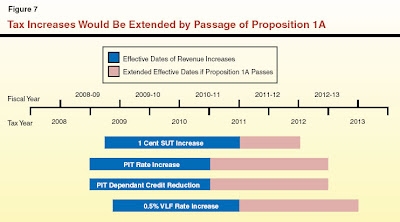
1A Raises Taxes By Extending Them

(Click Graph for Link)

Prop. 1A will raise taxes on all Californians and extend these taxes for one to two years, taking another $16 billion from you! The already approved tax increase will cost a typical California family $1,100 annually.

HIGHER SALES TAX! Proposition 1A will extend the sales tax hike for an additional full year. California taxpayers already pay the highest sales tax in the nation. This is a direct attack on all working families, especially low-income residents.

HIGHER CAR TAX! Proposition 1A will extend the DOUBLING of the car tax. This affects every California car owner.

HIGHER STATE INCOME TAX! Proposition 1A will extend an income tax increase for two extra years. Californians already pay the highest income tax rates in the nation. Under Prop. 1A, you’ll pay even more.

REDUCTION OF TAX CREDIT FOR DEPENDENTS! Californians with children will see a reduction in the tax credits for dependents, costing them $200 per child. Prop. 1A will extend this attack on families for an extra two years.

The Howard Jarvis Taxpayers Association is urging a vote of "NO" on Prop. 1A, which DOUBLES the tax increase!


  • Proposition 1B: Provides extra funds for schools and community colleges starting in 2011 to compensate for cuts in the current budget.
  • Proposition 1C: Allows the state to borrow $5 billion against future state lottery sales; allows the state to change the lottery system to generate more revenue and use funds for programs other than education.
  • Proposition 1D: Allows the state to divert $608 million from Proposition 10 (tobacco tax for children's health care) to general-fund costs of children's health care in the fiscal year beginning July 1, 2009. The amount drops to $268 million a year from July 1, 2010, to June 30, 2014.
  • Proposition 1E: Allows the state to divert $230 million a year from Proposition 63 (taxes the wealthy to fund mental health programs) to offset general fund costs of other mental health programs for two years beginning July 1, 2009.