Friday, February 26, 2010
Monday, February 01, 2010
Thomas Sowell on Intellectuals and Society - 37 minutes
The author of more than a dozen books, Dr. Sowell is now a senior fellow at the Hoover Institution. In his newest work, Intellectuals and Society, he will discuss why so many disasters of our time have been committed by experts or intellectuals. You may remember FDRs Brain Trust which according to later studies is a prolonged the depression by several years. The wiz kids at the pentagon under McNamara who managed to mess up the Vietnam War, you can run through an impressive list of things, of disasters brought about by people with very high IQs


Monday, January 18, 2010
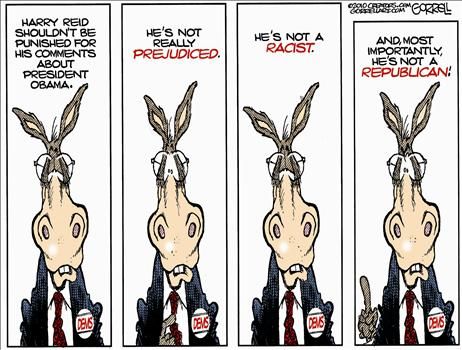
Differing Standards: Dems Can Be Racist, Repubs Cannot (Stephen A Smith calls for Harry Reid to Resign)
What to call black people has to be confusing to white people. Having been around for 73 years, I have been through a number of names. Among the polite ones are: colored, Negro, Afro-American, black, and now African-American. Among those names, African-American is probably the most unintelligent. You say, "What do you mean, Williams?" Suppose I told you that I had a European-American friend or a South-America-American friend, or a North-America-American friend. You'd probably say, "Williams, that's stupid. Europe, South America and North America are continents consisting of many peoples." You might insist that I call my friend from Germany a German-American instead of European-American and my friend from Brazil a Brazilian-American rather than a South-America-American and my friend from Canada a Canadian-American instead of a North-American. So would not the same apply to people whose heritage lies on the African continent? For example, instead of claiming that President Barack Obama is the first African-American president, it should be that he's the first Kenyan-American president. In that sense, Obama is lucky. Unlike most American blacks, he knows his national heritage; the closest to a national heritage the rest of us can identify is some country along Africa's gold coast.
Another problem with the African-American label is not all people of African ancestry are dark. Whites are roughly 10 percent of Africa's population and include not only European settlers but Arabs and Berbers as well. So is an Afrikaner who becomes a U.S. citizen a part of United States' African-American population? Should census takers and affirmative action/diversity bean counters count Arabs, Berbers and Afrikaners who are U.S. citizens as African-Americans and should they be eligible for racial quotas in college admittance and employment?
Are black Americans a minority group? When one uses the term minority, there is an inference that somewhere out there is a majority but in the United States we are a nation of minorities. According to the U.S. Census Bureau 2000 census, where people self-identify, the ancestry of our largest ethnic groups are people of German ancestry (15.2 percent), followed by Irish (10.8 percent), African (8.8), and English (8.7) ancestry. Of the 92 ethnic groups listed, in the census, 75 of them are less than 1 percent of our population.
Race talk often portrays black Americans as downtrodden and deserving of white people's help and sympathy. That vision is an insult of major proportions. As a group, black Americans have made some of the greatest gains, over the highest hurdles, in the shortest span of time than any other racial group in mankind's history. This unprecedented progress can be seen through several measures. If one were to total black earnings, and consider black Americans a separate nation, he would find that in 2005 black Americans earned $644 billion, making them the world's 16th richest nation -- that is just behind Australia but ahead of Netherlands, Belgium and Switzerland. Black Americans are, and have been, chief executives of some of the world's largest and richest cities such as New York, Chicago, Los Angeles, Philadelphia and Washington, D.C. It was a black American, Gen. Colin Powell, appointed Joint Chief of Staff in October 1989, who headed the world's mightiest military and later became U.S. Secretary of State, and was succeeded by Condoleezza Rice, another black American. Black Americans are among the world's most famous personalities and a few are among the richest. Most blacks are not poor but middle class.
On the eve of the Civil War, neither a slave nor a slave owner would have believed these gains possible in less than a mere century and a half, if ever. That progress speaks well not only of the sacrifices and intestinal fortitude of a people; it also speaks well of a nation in which these gains were possible. These gains would not have been possible anywhere else.
Did anyone ever call Franklin D. Roosevelt a "Dutch American" or Dwight Eisenhower a "German American"? It would have been resented, not only by them and their supporters, but by Americans in general. These men were Americans -- not hyphenated Americans or half Americans.
Most black families in the United States today have been here longer than most white families. No one except the American Indians can claim to have been on American soil longer. Why then call blacks in the United States "African Americans," when not even their great-great-great-grandparents ever laid eyes on Africa?
It is certainly understandable that activists, politicians and others who wish to divide Americans for their own purposes would push the notion of "African Americans." They also push such things as the "African" holiday Kwanzaa -- which originated in Los Angeles -- and "black English" or "ebonics," which originated centuries ago in particular localities in Britain, and is wholly unknown in Africa.
Names are just part of the process of creating wholesale frauds about the past, in order to advance special agendas in the present. Personal names are also part of that fraud.
The vogue of repudiating black family names that supposedly were given by slaveowners in times past is another reflection of the widespread ignorance of history among Americans in general, as a result of our dumbed-down education. Slaves were not only not given family names, they were forbidden to have family names.
In many parts of the world, family names began with the elites, and only over the centuries moved down the social scale until ordinary people were allowed to have them. In England, common people began to have family names only after the Middle Ages, and in Japan it was the late 19th century before commoners could use family names. It was the 20th century before ordinary people in Iran were allowed -- and directed -- to have family names.
Slaveowners in the American antebellum South were especially opposed to slaves having family names because such names emphasized family ties -- and the only legally recognized tie of a slave was to his owner, who could sell him miles away from his kin.
The slaves themselves, however, used family names to create a sense of family, though they were careful not to use these names around whites. Even after Emancipation, blacks who had been raised in slavery often hesitated when some white person asked them their family name.
The so-called "slave names" that so many blacks began repudiating in the 1960s, were neither given to them by slaveowners nor were they usually the slaveowners' family names. They were names chosen despite prohibitions, in order to symbolize family ties that were often stronger than those in today's ghettoes.
The late Herbert Gutman -- a tough-minded historian -- was once on the verge of tears as he described the desperate efforts of blacks in the years after Emancipation to try to find family members who had been sold, sometimes hundreds of miles away. These poor and illiterate people would find somebody who could read and write, who would write what were called "inquiring letters" to black churches in the South. In these churches, someone would then read these letters aloud to the congregations, asking if anybody who knew anything about the person being sought would speak up, so that this family could be reunited again.
Those who try to claim that the shattered families in today's ghettoes are "a legacy of slavery" ignore the fact that, a hundred years ago, a slightly higher percentage of blacks than of whites were married and most black children were raised in two-parent families, even during the era of slavery.
As late as 1950, a higher percentage of black women than of white women were married. The broken families of today are a legacy of our own times and our own ill-advised notions and policies.
Of all the reactions against the supposed "slave names" among blacks, the most painfully ironic has been the taking of Arab names instead. The Arabs engaged in massive enslavement of Africans before the Europeans began to -- and continued long after the Europeans stopped.
One of the many reasons for studying history is to prevent history from being misused for current hidden agendas. Names are just one of the things being misused in thisway.
Monday, November 09, 2009
Monday, November 02, 2009
"The Economics of Medical Care" Chapter from Thomas Sowell's book, Applied Economics: Thinking Beyond Stage One, Linked at Investors Business Daily

Dr. Sowell has granted IBD permission to run one of the chapters of Applied Economics: Thinking Beyond Stage One — The Economics of Medical Care — in its entirety. We are doing so because of its relevance to the debate over health care reform. The chapter will run in nine parts over the next week and a half.
Part 1
Thomas Sowell On Economics Of Medical Care
The high cost of medical care has been a recurrent theme in countries around the world. In the United States, medical expenses absorb about one-sixth of the total annual output of the economy.
Medical care is one of many goods and services that can be provided in a wide variety of ways. At one time, it was common for sick people simply to pay doctors and buy medicine individually with their own money.
Today, both the medicines and the medical care are often paid for by third parties through either political or market institutions — that is, either by insurance companies or government agencies, or both, with or without some portion being paid by the individual patient.
Read More
Part 2
How Quantity Of Medical Care Is Influenced By Price Controls
Just as artificially low housing prices have led many people to seek their own separate housing units who would not ordinarily do so, if they had to pay the full costs in a free market, so artificially less expensive — in some countries, free — medical care has led many people with minor medical problems to absorb far more of doctors' time and expensive medicines and treatments than they would if they had to pay the costs themselves.
Read More
Part 3
How Payment By Third Parties Distorts Health Care Decisions
Third-party payments are at the heart of much confusion about the cost of medical treatment— and are a major factor in the increased cost of that treatment.
In government-run medical systems, the public pays in taxes for its medical care, either wholly or in part, with a share being paid directly by the individual patient.
Political slogans about "bringing down the cost of medical care" are almost invariably about programs or policies directed toward lowering the price paid directly by the patient. But the fact that only part of the costs are reimbursed by direct out-of-pocket payments from individual patients to doctors, hospitals or pharmacies in no way indicates that the total cost of the particular medical treatment is any lower than before.
Read More
Part 4
Costs Of Malpractice Insurance Go Beyond Doctors' Premiums
A major source of the high cost of American medical care is malpractice insurance for doctors and hospitals.
The average cost of this insurance for individual doctors ranges from about $14,000 a year in California to nearly $40,000 a year in West Virginia. In particular specialties, such as obstetrics and neurosurgery, the cost of malpractice insurance can exceed $200,000 a year in some places.
Read More
Tuesday, October 20, 2009
Should Rush Sue? Thomas Sowell Import

To sue or not to sue? That is the question.
After racist statements were made up out of thin air and then attributed to Rush Limbaugh, these were the options he had.
It is easy for me to understand that these are not simple choices because I have faced those options as well. Recently there have been a number of columns made up by others and put on the Internet with my name on them. The things said in those bogus columns have nothing in common with anything that I have said, in my columns, in my books or anywhere else.
Years ago, CBS reporter Lem Tucker said in a broadcast on October 13, 1981 that my views "seem to place him in the school that believes that maybe most blacks are genetically inferior to white people."
Anyone interested in the facts could have discovered that I had argued directly against this idea in a number of writings, including a feature article in the New York Times Magazine on March 27, 1977.
An attorney I did not know, but who had read my writings and knew that what was insinuated in that broadcast was totally false, offered to represent me in a lawsuit against CBS. That was when I faced the kind of dilemma that Rush Limbaugh faces now.
When someone is considered to be a "public figure"-- and Rush Limbaugh is certainly that-- the Supreme Court has narrowed the grounds on which that public figure can sue for libel, to the point where even the most blatant lie can often go unpunished.
Worse yet, there may be millions of people who never heard the original lie but who will hear it repeated in the media as a result of news stories about the lawsuit. And when those who committed character assassination are let off the hook on a technicality, they can claim "vindication," as if what they said was true.
The question facing any public figure who has been the target of character assassination in the media is: Is it worth investing a large amount of time in a process that can make you worse off by spreading the very lie that you are suing to stop?
The down side of not suing is that it allows the lie to continue to be repeated in the media, with later repetitions being justified in terms of "just reporting" what someone else said.
No one can resolve this dilemma for someone else. My decision in 1981 was that I had too many other things to do for me to go into the exhausting and time-consuming process of suing CBS, with such dicey odds in the courts.
Every situation is different, so whether Rush Limbaugh should sue is a question that only he can answer.
The question for the media to answer is: Are lies to go unchallenged when they are lies against someone you disagree with? Worse yet, are they to be excused, rationalized or even repeated?
Already there are people on television saying that, although Rush didn't actually say the things that have been attributed to him, he has said other things that they choose to call "racist."
If those other things really are racist, why don't they quote them, instead of something that was made up out of whole cloth?
The Rush Limbaugh show has, after all, been broadcast for many years, three hours a day. There are thousands of hours of those broadcasts that people can go back through to look for things to quote.
If critics can't find anything racist in all that material, why should an outright lie about what the man said be given a pass?
As the late Senator Daniel Patrick Moynihan said, you are entitled to your own opinion but not to your own facts.
Ultimately, this is not about Rush Limbaugh or anybody else who is smeared with impunity. It is about the whole climate in which issues are discussed.
Without a range of opposing opinions being available to the public, the basic concept of a self-governing democracy is a mockery. If views that some people don't like can be silenced or discredited by character assassination, the whole country loses.
The courts should not be the only line of defense. Common decency should be the first line of defense, so that people who smear others will pay a price in the outrage that their lies should provoke, even among decent people who do not agree with the target of their smears.

Friday, January 02, 2009
TIMELESS! Thomas Sowell on Public Education
Monday, December 29, 2008
Sowell on the "Depression" (Imported Article)
Another Great Depression?
Thomas Sowell
Tuesday, December 23, 2008
With both Barack Obama's supporters and the media looking forward to the new administration's policies being similar to President Franklin D. Roosevelt's policies during the 1930s depression, it may be useful to look at just what those policies were and-- more important-- what their consequences were.
The prevailing view in many quarters is that the stock market crash of 1929 was a failure of the free market that led to massive unemployment in the 1930s-- and that it was intervention of Roosevelt's New Deal policies that rescued the economy.
It is such a good story that it seems a pity to spoil it with facts. Yet there is something to be said for not repeating the catastrophes of the past.
Let's start at square one, with the stock market crash in October 1929. Was this what led to massive unemployment?
Official government statistics suggest otherwise. So do new statistics on unemployment by two current scholars, Richard Vedder and Lowell Gallaway, in their book "Out of Work."
The Vedder and Gallaway statistics allow us to follow unemployment month by month. They put the unemployment rate at 5 percent in November 1929, a month after the stock market crash. It hit 9 percent in December-- but then began a generally downward trend, subsiding to 6.3 percent in June 1930.
That was when the Smoot-Hawley tariffs were passed, against the advice of economists across the country, who warned of dire consequences.
Five months after the Smoot-Hawley tariffs, the unemployment rate hit double digits for the first time in the 1930s.
This was more than a year after the stock market crash. Moreover, the unemployment rate rose to even higher levels under both Presidents Herbert Hoover and Franklin D. Roosevelt, both of whom intervened in the economy on an unprecedented scale.
Before the Great Depression, it was not considered to be the business of the federal government to try to get the economy out of a depression. But the Smoot-Hawley tariff-- designed to save American jobs by restricting imports-- was one of Hoover's interventions, followed by even bigger interventions by FDR.
The rise in unemployment after the stock market crash of 1929 was a blip on the screen compared to the soaring unemployment rates reached later, after a series of government interventions.
For nearly three consecutive years, beginning in February 1932, the unemployment rate never fell below 20 percent for any month before January 1935, when it fell to 19.3 percent, according to the Vedder and Gallaway statistics.
In other words, the evidence suggests that it was not the "problem" of the financial crisis in 1929 that caused massive unemployment but politicians' attempted "solutions." Is that the history that we seem to be ready to repeat?
The stock market crash, which has been blamed for the widespread suffering during the Great Depression of the 1930s, created no unemployment rate that was even half of what was created in the wake of the government interventions of Hoover and FDR.
Politically, however, Franklin D. Roosevelt could not have been more successful. After all, he was the only President of the United States elected four times in a row. He was a master of political rhetoric.
If Barack Obama wants political success, following in the footsteps of FDR looks like the way to go. But people who are concerned about the economy need to take a closer look at history. We deserve something better than repeating the 1930s disasters.
There is yet another factor that provides a parallel to what happened during the Great Depression. No matter how much worse things got after government intervention under Roosevelt's New Deal policies, the party line was that he had to "do something" to get us out of the disaster created by the failure of the unregulated market and Hoover's "do nothing" policies.
Today, increasing numbers of scholars recognize that FDR's own policies were a further extension of interventions begun under Hoover. Moreover, the temporary rise in unemployment after the stock market crash was nowhere near the massive and long-lasting unemployment after government interventions.
Barack Obama already has his Herbert Hoover to blame for any and all disasters that his policies create: George W. Bush.
Wednesday, December 03, 2008
Friday, October 03, 2008
Thomas Sowell on Bailout

Nothing could more painfully demonstrate what is wrong with Congress than the current financial crisis.
Among the Congressional "leaders" invited to the White House to devise a bailout "solution" are the very people who have for years created the risks that have now come home to roost.
Five years ago, Barney Frank vouched for the "soundness" of Fannie Mae and Freddie Mac, and said "I do not see" any "possibility of serious financial losses to the treasury."
Moreover, he said that the federal government has "probably done too little rather than too much to push them to meet the goals of affordable housing."
 Earlier this year, Senator Christopher Dodd praised Fannie Mae and Freddie Mac for "riding to the rescue" when other financial institutions were cutting back on mortgage loans. He too said that they "need to do more" to help subprime borrowers get better loans.
In other words, Congressman Frank and Senator Dodd wanted the government to push financial institutions to lend to people they would not lend to otherwise, because of the risk of default.
The idea that politicians can assess risks better than people who have spent their whole careers assessing risks should have been so obviously absurd that no one would take it seriously.
But the magic words "affordable housing" and the ugly word "redlining" led to politicians directing where loans and investments should go, with such things as the Community Reinvestment Act and various other coercions and threats.
The roots of this problem go back many years, but since the crisis to which all this led happened on George W. Bush's watch, that is enough for those who think in terms of talking points, without wanting to be confused by the facts.
In reality, President Bush tried unsuccessfully, years ago, to get Congress to create some regulatory agency to oversee Fannie Mae and Freddie Mac.
N. Gregory Mankiw, his Chairman of the Council of Economic Advisers, warned in February 2004 that expecting a government bailout if things go wrong "creates an incentive for a company to take on risk and enjoy the associated increase in return."
Since risky investments usually pay more than safer investments, the incentive is for a government-supported enterprise to take bigger risks, since they get more profit if the risks pay off and the taxpayers get stuck with the losses if not. 
The government does not guarantee Fannie Mae or Freddie Mac, but the widespread assumption has been that the government would step in with a bailout to prevent chaos in financial markets.
Alan Greenspan, then head of the Federal Reserve System, made the same point in testifying before Congress in February 2004. He said: "The Federal Reserve is concerned" that Fannie Mae and Freddie Mac were using this implicit reliance on a government bailout in a crisis to take more risks, in order to "multiply the profitability of subsidized debt."
Chairman Greenspan added his voice to those urging Congress to create a "regulator with authority on a par with that of banking regulators" to reduce the riskiness of Fannie Mae and Freddie Mac, a riskiness ultimately borne by the taxpayers.
Fannie Mae and Freddie Mac do not deserve to be bailed out, but neither do workers, families and businesses deserve to be put through the economic wringer by a collapse of credit markets, such as occurred during the Great Depression of the 1930s.
Neither do the voters deserv e to be deceived on the eve of an election by the notion that this is a failure of free markets that should be replaced by political micro-managing.
If Fannie Mae and Freddie Mac were free market institutions they could not have gotten away with their risky financial practices because no one would have bought their securities without the implicit assumption that the politicians would bail them out.
It would be better if no such government-supported enterprises had been created in the first place and mortgages were in fact left to the free market. This bailout creates the expectation of future bailouts.