Showing posts with label The Best of Conservatism. Show all posts
Showing posts with label The Best of Conservatism. Show all posts
Monday, April 12, 2010
Tuesday, March 23, 2010
Saturday, March 13, 2010
Saturday, February 20, 2010
Thursday, February 18, 2010
Tuesday, January 26, 2010
Monday, January 25, 2010
Monday, January 18, 2010
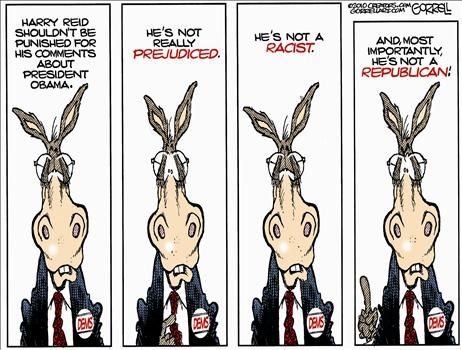
Differing Standards: Dems Can Be Racist, Repubs Cannot (Stephen A Smith calls for Harry Reid to Resign)
What to call black people has to be confusing to white people. Having been around for 73 years, I have been through a number of names. Among the polite ones are: colored, Negro, Afro-American, black, and now African-American. Among those names, African-American is probably the most unintelligent. You say, "What do you mean, Williams?" Suppose I told you that I had a European-American friend or a South-America-American friend, or a North-America-American friend. You'd probably say, "Williams, that's stupid. Europe, South America and North America are continents consisting of many peoples." You might insist that I call my friend from Germany a German-American instead of European-American and my friend from Brazil a Brazilian-American rather than a South-America-American and my friend from Canada a Canadian-American instead of a North-American. So would not the same apply to people whose heritage lies on the African continent? For example, instead of claiming that President Barack Obama is the first African-American president, it should be that he's the first Kenyan-American president. In that sense, Obama is lucky. Unlike most American blacks, he knows his national heritage; the closest to a national heritage the rest of us can identify is some country along Africa's gold coast.
Another problem with the African-American label is not all people of African ancestry are dark. Whites are roughly 10 percent of Africa's population and include not only European settlers but Arabs and Berbers as well. So is an Afrikaner who becomes a U.S. citizen a part of United States' African-American population? Should census takers and affirmative action/diversity bean counters count Arabs, Berbers and Afrikaners who are U.S. citizens as African-Americans and should they be eligible for racial quotas in college admittance and employment?
Are black Americans a minority group? When one uses the term minority, there is an inference that somewhere out there is a majority but in the United States we are a nation of minorities. According to the U.S. Census Bureau 2000 census, where people self-identify, the ancestry of our largest ethnic groups are people of German ancestry (15.2 percent), followed by Irish (10.8 percent), African (8.8), and English (8.7) ancestry. Of the 92 ethnic groups listed, in the census, 75 of them are less than 1 percent of our population.
Race talk often portrays black Americans as downtrodden and deserving of white people's help and sympathy. That vision is an insult of major proportions. As a group, black Americans have made some of the greatest gains, over the highest hurdles, in the shortest span of time than any other racial group in mankind's history. This unprecedented progress can be seen through several measures. If one were to total black earnings, and consider black Americans a separate nation, he would find that in 2005 black Americans earned $644 billion, making them the world's 16th richest nation -- that is just behind Australia but ahead of Netherlands, Belgium and Switzerland. Black Americans are, and have been, chief executives of some of the world's largest and richest cities such as New York, Chicago, Los Angeles, Philadelphia and Washington, D.C. It was a black American, Gen. Colin Powell, appointed Joint Chief of Staff in October 1989, who headed the world's mightiest military and later became U.S. Secretary of State, and was succeeded by Condoleezza Rice, another black American. Black Americans are among the world's most famous personalities and a few are among the richest. Most blacks are not poor but middle class.
On the eve of the Civil War, neither a slave nor a slave owner would have believed these gains possible in less than a mere century and a half, if ever. That progress speaks well not only of the sacrifices and intestinal fortitude of a people; it also speaks well of a nation in which these gains were possible. These gains would not have been possible anywhere else.
Thomas Sowell
March 18, 2002
Did anyone ever call Franklin D. Roosevelt a "Dutch American" or Dwight Eisenhower a "German American"? It would have been resented, not only by them and their supporters, but by Americans in general. These men were Americans -- not hyphenated Americans or half Americans.
Most black families in the United States today have been here longer than most white families. No one except the American Indians can claim to have been on American soil longer. Why then call blacks in the United States "African Americans," when not even their great-great-great-grandparents ever laid eyes on Africa?
It is certainly understandable that activists, politicians and others who wish to divide Americans for their own purposes would push the notion of "African Americans." They also push such things as the "African" holiday Kwanzaa -- which originated in Los Angeles -- and "black English" or "ebonics," which originated centuries ago in particular localities in Britain, and is wholly unknown in Africa.
Names are just part of the process of creating wholesale frauds about the past, in order to advance special agendas in the present. Personal names are also part of that fraud.
The vogue of repudiating black family names that supposedly were given by slaveowners in times past is another reflection of the widespread ignorance of history among Americans in general, as a result of our dumbed-down education. Slaves were not only not given family names, they were forbidden to have family names.
In many parts of the world, family names began with the elites, and only over the centuries moved down the social scale until ordinary people were allowed to have them. In England, common people began to have family names only after the Middle Ages, and in Japan it was the late 19th century before commoners could use family names. It was the 20th century before ordinary people in Iran were allowed -- and directed -- to have family names.
Slaveowners in the American antebellum South were especially opposed to slaves having family names because such names emphasized family ties -- and the only legally recognized tie of a slave was to his owner, who could sell him miles away from his kin.
The slaves themselves, however, used family names to create a sense of family, though they were careful not to use these names around whites. Even after Emancipation, blacks who had been raised in slavery often hesitated when some white person asked them their family name.
The so-called "slave names" that so many blacks began repudiating in the 1960s, were neither given to them by slaveowners nor were they usually the slaveowners' family names. They were names chosen despite prohibitions, in order to symbolize family ties that were often stronger than those in today's ghettoes.
The late Herbert Gutman -- a tough-minded historian -- was once on the verge of tears as he described the desperate efforts of blacks in the years after Emancipation to try to find family members who had been sold, sometimes hundreds of miles away. These poor and illiterate people would find somebody who could read and write, who would write what were called "inquiring letters" to black churches in the South. In these churches, someone would then read these letters aloud to the congregations, asking if anybody who knew anything about the person being sought would speak up, so that this family could be reunited again.
Those who try to claim that the shattered families in today's ghettoes are "a legacy of slavery" ignore the fact that, a hundred years ago, a slightly higher percentage of blacks than of whites were married and most black children were raised in two-parent families, even during the era of slavery.
As late as 1950, a higher percentage of black women than of white women were married. The broken families of today are a legacy of our own times and our own ill-advised notions and policies.
Of all the reactions against the supposed "slave names" among blacks, the most painfully ironic has been the taking of Arab names instead. The Arabs engaged in massive enslavement of Africans before the Europeans began to -- and continued long after the Europeans stopped.
One of the many reasons for studying history is to prevent history from being misused for current hidden agendas. Names are just one of the things being misused in thisway.


Thursday, January 07, 2010
Wednesday, December 16, 2009
Tuesday, December 08, 2009
Afghan President Hamid Karzai Says Afghanistan Needs 15-20 Years of Assistance
I found this very interesting, for the main reason that he knows that to have a government in power like that is moderate and concerned about freedom (corrupt or not) for a generation (20-years) is very important and may be the most powerful change factor Afghanistan needs. Israel needed two generations to loose most of what they had been taught while slaves in Egypt. Dr. Ken Jowitt talks about this here:
Sunday, December 06, 2009
What is Conservatism?... is it Liberal or Classically Liberal? (Whats the Difference?) -- Robert P. George

THAT conservatism rejects much of contemporary liberalism is clear enough. Yet many conservatives speak favorably of "liberal democracy" and its defense. Indeed, they sometimes seem to speak this way more than contemporary liberals do. They use the word "illiberal," meanwhile, to describe many of the ideas and policies they oppose. Some of those typically labeled "conservatives" go so far as to call themselves "classical liberals." The implication of these usages seems to be that conservatism may stand in friendlier relation to older forms of liberalism.

We posed to four eminent political thinkers the question: Should American conservatism be understood as a branch of liberalism, in that liberal institutions and a liberal society are what it chiefly aims to conserve? Their answers appear below.
Robert P. George
ORTHODOX CONTEMPORARY LIBERALISM, the liberalism of Teddy Kennedy and Barney Frank, combines statist social and economic policies with a fierce commitment to lifestyle libertarianism. An earlier strain of liberalism, embodied by Franklin D. Roosevelt, embraced the statism without the lifestyle libertarianism. In its full flower (think of Hubert Humphrey), this form was strongly committed to civil rights--true civil rights, not "civil rights" as a euphemism for lifestyle libertarianism--and to their advancement through national governmental power. More venerable yet is the "old-fashioned liberalism" of Madison and Tocqueville. No mere relic of the past, it counts many contemporary conservatives among its adherents.
Old-fashioned liberalism embraces neither statism nor libertarianism, whether in social and economic policy or on lifestyle issues. Though it insists on constitutional checks on government to protect honorable liberties and the integrity of the family and other institutions of civil society, it does not regard government as an evil. Rather, it understands well-functioning and limited government as indispensable to the common good. While principle dictates government involvement in some matters and forbids it in others, old-fashioned liberalism emphasizes the prudential nature of most policy judgments concerning the regulation of markets or morals. Though they reject unprincipled pragmatism, old-fashioned liberals prize moderation and caution in the vast range of political decision-making that is not determined by principles alone.
That do old-fashioned liberals support? Religious freedom and other basic human rights; political equality and equality of opportunity; constitutional democracy, wherever possible; the rule of law; limited but effective government; a flourishing civil society (including a healthy marriage-and-family culture, vibrant religious communities, and civic associations); personal responsibility; and the market economy, regulated to function for the common good.
Central to old-fashioned liberalism is a belief in the profound, inherent, and equal dignity of every member of the human family. Thus old-fashioned liberals are called conservatives in an age in which not only statism but also abortion, embryo-destructive research, euthanasia, and even eugenics are promoted as progressive causes. Many old-fashioned liberals are Christians or Jews; though prepared to defend their views without appeal to religious authority, they find the scriptural articulation of their core ethical-political commitment in the teaching of Genesis that man is made in God's image and likeness.
How is old-fashioned liberalism liberal? It emerged in opposition to European "throne and altar" conservatism, with its monarchism, corporatism, political inequalities, and indifference or hostility to religious freedom and other basic civil liberties and rights. This brand of conservatism was never salient in America. Our conservatives have respected religion and tradition. But they have rightly regarded freedom of religion as necessary for faith's flourishing in modern conditions, and the traditions they have sought to preserve favor constitutionalism, the rule of law, civil liberties, the market economy, limited government, personal responsibility, and civic order and virtue.
Many contemporary conservatives were once Humphrey-type liberals; some--including Mary Ann Glendon, Leon and Amy Kass, and the late Fr. Richard John Neuhaus--were themselves civil-rights activists. It was their commitment to human dignity that led them both into the civil-rights movement and then out of the liberal fold when lifestyle libertarianism became liberal orthodoxy. They did not change their fundamental beliefs; what changed was what counted as liberal. And while remaining loyal to the causes of civil rights and equal opportunity, they came to believe that big-government economic and social policies failed to help, and often actually hurt, their intended beneficiaries by, for example, eroding the sense of personal responsibility and by undermining the marriage culture, thus entrenching the poverty against which great civil rights-era liberals such as Humphrey proposed to wage war.
Old-fashioned liberals can make common cause with contemporary libertarians against statist policies now being advanced by President Obama and the Reid-Pelosi Congress. In some cases, however, the old-fashioned liberal critique will differ in important ways from the libertarian critique. The former will often focus on considerations of prudence, not principle (though prudential judgments are often shaped by underlying principled commitments). Where libertarians see a threat to the individual's freedom to do as he pleases, the old-fashioned liberal may see a threat to the autonomy of the family, religious communities, and other institutions of civil society. This will likely be true of debates over health care, education, and taxation.
On lifestyle issues, cooperation with strict libertarians will be more limited. But a significant minority of libertarians are pro-life, and many oppose (for good libertarian reasons) government sex-education programs and population policies.
Opportunities for cooperation with orthodox contemporary liberals are fewer. The Obama administration and Congress seem determined to advance the causes of abortion and embryo-destructive research, and their social and economic policies would shift authority and resources from families and private enterprises to the government.
Indeed, Obama, Reid, and Pelosi represent contemporary liberal orthodoxy in its purest distillation. Carter, Clinton, and previous Democratic congressional leaders cannot begin to compare. It is as if the country were being run by Ivy League faculty. In fact, strike the "as if."
So old-fashioned liberals will likely have little choice but to oppose the Obama administration and Congress at virtually every turn, for contemporary liberal orthodoxy is the antithesis of the old-fashioned liberal brand of conservatism.
Mr. George is McCormick Professor of Jurisprudence at Princeton University and a member of the Hoover Institution Task Force on the Virtues of a Free Society. He is the founder of the American Principles Project (www.americanprinciplesproject.org).
Wednesday, December 02, 2009
Palin for Pres? O'yu Betchya (lots of meaning in them thare poster)

This is a reader h/t (a fellow Giordano), and it comes from Out-of-Order:
Move over, Rosie the Riveter. Here comes Sarah, and it’s not just rivets she’s packing. –All Right Magazine
No matter how you feel about Alaska's former governor, everyone has an opinion. Today, America is arguably in peril from forces potentially as destructive as Nazi Germany and Imperial Japan. During WWII Rosie the Riveter kept 'em flying, and today when most of our "conservative" leaders are majoring in hand-wringing, the girls are stepping up. – Dale
(Out-of-Order -- Sarah Para Bellum)
I did find an anti-Palin spoof site because of this poster that is genuinely funny and is a good lesson in sarcasm (PalinAsPresident). At any rate, the poster clicks out, but I must also post this latest Rush warning to those Conservatives "out there," we must fight for the soul of the Republican Party:
Wednesday, November 25, 2009
Saturday, November 21, 2009
Rifqa Bary Panel: Robert Spencer, Pamela Geller, Dr. Andrew Bostom
Some great minds in this warning for those who will listen -- media scores bad in this common sense critique.
Wednesday, November 04, 2009
Homosexuals Against Same-Sex Marriage (Re-Post)

"We're not married, Let's get that straight. We have a civil partnership. I don't want to be married! I'm very happy with a civil partnership. The word 'marriage,' I think, puts a lot of people off. You get the same equal rights that we do when we have a civil partnership. Heterosexual people get married. We can have civil partnerships."
~ Elton John ~
You may view my critique on same-sex marriages being the same, ontologically, as heterosexual marraiges, this paper is entitled, "Epicurean Romanism: Natural Law & Romans." Also see this case study, "Redefining marriage or deconstructing society: a Canadian case study," by homosexual psychologist, Paul Nathanson (it is multiple pages and I must h/t Come Reason Ministries via there podcast for this study).
Tammy Bruce -- a pro-choice lesbian, agrees with Elton John as explained in this article on her site, "Gay Marriage: Why Not?" (there is a more in-depth link that is connected with the article):
 The political debate rumbles on, and we've heard the principle arguments repeated endlessly: On one hand, the right of gays to seek the same legal protections available to straights, and on the other hand, the mainstream desire to preserve an ancient and fundamental institution. Perhaps there's a more appropriate way to look at this. Seems to me there's an element of narcissism on both sides of the standard argument: On one hand, MY rights; on the other hand, MY tradition. But maybe it's not about YOU. Marriage may make us happy (or miserable, as the case may be), but its primary purpose is to create a stable environment into which children will be born and nurtured through adolescence. Certainly both our statistics and common sense tell us that children do vastly better if they grow up with loving parents, a mother and a father. For this reason, I'd rather view the battle for marriage as a children's rights issue, rather than a ME ME MINE issue.
Looked at from this perspective, the problem with gay marriage isn't that it's objectively any worse than (and it may actually be better than) the broken homes and single parents and all the other indications that modern marriage is a ruined institution. The problem with gay marriage is fundamentally symbolic: It's the societal acknowledgement of how far marriage has fallen. If not for the specter of gay marriage, we could continue to pretend that we're still functional. We could pay our hypocritical respects to our ideal, even if that ideal no longer translates into any semblance of reality.
If you get past the politics and the rants, you'll hear many conservative Christians acknowledge as much. They understand that winning the battle against gay marriage doesn't mean a thing unless marriage itself once again becomes respected and meaningful.
Just as the 2nd Amendment wasn't adopted to protect your right to hunt, so the institution of marriage wasn't created to deliver spousal health insurance and inheritance. Don't let the politics distract you from the big picture. This battle is in one place but the war is elsewhere.
In ancient times before Abraham, pagans sacrificed their children to idols. This is a matter of historical record. Then, as our tradition would have it, God gave us the example of Abraham and Isaac to declare an end to ritual human slaughter. In our modern, enlightened era, it seems we've created a new form of child sacrifice. Children have become disposable. Most of us know this is our fundamental problem. Some say that the government must step in and pick up the slack with day care and the like. Others argue that the parental commitment must be enforced. The liberal/conservative divide forms roughly along these lines. This is where the war is.
Bottom line: If we've lost marriage, then it really doesn't matter what becomes of gay marriage. Think about this before you jump back into the culture war.
Related Link:
Tammy's column from 2004 on the issue: Respecting Marriage and Equal Rights
Likewise, Al Rantel in his article entitled, "Gay Talk Show Host Opposes Gay Marriage," makes the point that as a gay man, he opposes gay marriage:
The Massachusetts Supreme Judicial Court ruling by four of the seven justices that the state must allow gays full marriage rights by May 17th raises a myriad of questions that some are afraid to ask in this time of political correctness run amok.
First and foremost of those questions is who said gays want to get married in the first place? Lets look at the numbers. The highest number of same sex households in America is ironically in Massachusetts, however even then it is under 2 per cent of all households. If gays make up five to ten per cent of the population as is often claimed, one would expect this number to be five times larger.
As distressing as the state of the American family is today with the high rate of divorce and adultery, the situation is far less stable among gays. This is not a slur against gays as individuals, but rather the reality of what occurs when you have what I call the all gas and no brake environment of male/male sexuality. I should know. I am a gay male.
To say that unfortunately the gay world is in a general state of hyper-sexuality that is not conducive to relationships which marriage was intended to foster is to put it mildly. Further, almost all of the issues the gay left claims it is justifiably concerned about like property, health, and financial partnership issues have already been dealt with by many states and can be dealt with through further legislation as needed. Such legal changes would encounter far less political opposition.
Why then the seeming obsession by the gay left and their activist judicial allies like the Massachusetts justices to force gay marriage on an unwilling public?
There is an answer.
Forcing a change to an institution as fundamental and established by civilization as marriage is deemed by gay activists and other cultural liberals as the equivalent of the Good Housekeeping seal of approval for homosexuality itself. The reasoning goes that if someone can marry someone of the same sex then being gay is as acceptable and normal as being short or tall.
While I certainly do not think people should be judged by who they choose to love or how they choose to live their lives, the cultural liberals in America are after more than that. They want to force others to accept their social view, and declare all those who might have an objection to their social agenda to be bigots, racists, and homophobes to be scorned and forced into silence.
The gay left has still not matured into a position of self-empowerment, but is still committed by and large to the idea that the rest of society must bless being gay in every way imaginable. This includes public parades in all major cities to remind everyone else of what some people like to do in their private bedrooms while in the same breath demanding to be left alone.
What more certifiable blessing than state sanctioned marriage of two men or two women, even for a group that has offered no indication that most even desire to enter into the kind of commitments that marriage ideally entails, or that serves the real purpose of marriage. Marriage exists in order to create a stable and  structured environment for couples to reproduce and raise their offspring.
And so we have come to yet another chapter in the story of those who would portray themselves as victims in need of another sanction from the state. This time the price of social acceptance of gays is the redefinition of an institution that is thousands of years old and a cornerstone of society. Does that really seem like a wise and prudent choice for America to make at the wish of a handful of judges, and at the behest of those whose real goals are more political than anything else?
Al Rantel is a radio talk show host on Los Angeles' KABC.
Paul Nathanson, a sociologist, a scholar, and a homosexual writes that there are at least five functions that marriage serves--things that every culture must do in order to survive and thrive. They are:
- Foster the bonding between men and women
- Foster the birth and rearing of children
- Foster the bonding between men and children
- Foster some form of healthy masculine identity
- Foster the transformation of adolescents into sexually responsible adults
Note that Nathanson considers these points critical to the continued survival of any culture. He continues "Because heterosexuality is directly  related to both reproduction and survival, ... every human societ[y] has had to promote it actively . ... Heterosexuality is always fostered by a cultural norm" that limits marriage to unions of men and women. He adds that people "are wrong in assuming that any society can do without it."
Nathanson, Paul as quoted in "Questions and Answers: What's Wrong With Letting Same-Sex Couples 'Marry?'" by Peter Sprigg http://www.frc.org/index.cfm?i=IF03H01&f=WU03L06
Subscribe to:
Posts (Atom)