Showing posts with label Energy Policy. Show all posts
Showing posts with label Energy Policy. Show all posts
Monday, April 26, 2010
Wednesday, February 24, 2010
Saturday, February 13, 2010
Friday, February 12, 2010
Monday, October 19, 2009
Battle of Enviro-Whacks -- Solar vs Species & Plants
(FlashReport h/t)
See my previous post (click the photo) where you find this quote:
See my previous post (click the photo) where you find this quote:
- Again, the big concerns seem to be moderately high energy costs to build solar panels, and considerable toxic waste exposure issues in making and disposing of solar panels. By the European Union's estimate, these are greater concerns than nuclear waste or nuclear accidents.

Several companies seek to build renewable-energy facilities on public land -- a goal backed by the White House -- but the slow permit process and fears over imperiled species have hindered construction.
Reporting from El Centro, Calif. - Across the desert flatlands of southeastern California, dozens of companies have flooded federal offices with applications to place solar mirrors on more than a million acres of public land.
But just as some of those projects appear headed toward fruition, environmental hurdles threaten to jeopardize efforts to further tap the region's renewable energy potential.
The development of solar-power facilities in the desert has been a top priority of the Obama administration as it seeks to ease the nation's dependence on fossil fuels and curb global warming. In addition, Gov. Arnold Schwarzenegger has urged that the state meet one-third of its electricity needs from renewable sources by 2020.
Companies are racing to finalize their permits and break ground by the end of next year, which would qualify them to obtain some of the $15 billion in federal stimulus funds designated for renewable energy projects. At stake is the creation of 48,000 jobs and more than 5,300 megawatts of new energy, enough to power almost 1.8 million homes, according to federal land managers.
But the presence of sensitive habitat, rare plants and imperiled creatures such as desert tortoises, bighorn sheep and flat-tailed horned lizards threatens to stall or derail some of the projects closest to securing permits.
"There are significant environmental issues involved in the California gold rush-like scenario unfolding in the desert," said Peter Galvin, conservation director of the Center for Biological Diversity. "We are not going to just roll over when critical wild lands and last habitats of endangered species are in the mix."


Wednesday, July 01, 2009
Energy Craze = Nanny State
Some must read articles from RealClearPolitics that show how much of a "Nanny State" we are becoming (the Left wants to have enough power [pun] to tell us what kind of light bulb we should use), aenrgy related taxes and intrusions (remember "pay-go"). A woman may make the choice to kill her child inutero, but I can't choose a light bulb... the logic of the Left for ya.
Energizing the Senate Cap and Trade Bill Lisa Lerer, Politico
Energy Department Announces New Light Standards Steven Mufson, Washington Post
Pelosi Used Personal Touch To Win Climate Vote Alan Ota, CQ Politics
Obama Considers Middle Class Tax Hike for Cap and Trade Peter Roff, US News & World Report
Cap and Trade Will Have Unexpected Costs Mark Vargus, Examiner.com
Friday, May 01, 2009
EPA Going "Green" (Green Is the New Red -- In Case You Were Wondering)

We all knew this was coming, however, it came quickly. Below is a small portion of a larger article that will spell economic slow down, and the price of goods rising in cost. Not to mention that Obama plans on, yes -- plans on raising gas prices (via cap n' trade) in order to make gas more expensive and in a sense force people to choose alternative forms of transportation (hybrids, which are worse for the environment; and trains and buses). Liberals want to run/change other peoples lives, conservatives want to run/change our own lives. This is just an example:
EPA rapidly reversing Bush policiesYou think energy was expensive before... wait.
Latest reversals cheered by environmentalists
(Wash Times) The Navajo Nation plans to earn $50 million annually by building a coal-fired power plant on its New Mexico reservation. But its plans hit a snag earlier this week, when the Environmental Protection Agency, citing air pollution concerns, moved to revoke a Bush administration permit and block the project.
Similar "green" reversals have grown commonplace at EPA, where Administrator Lisa Jackson has systematically upended the agency's pro-industry tendencies of the past eight years. She has replaced them with decisions that strongly favor environmentalists, a trend that is likely to accelerate as she undertakes a top-to-bottom agency review....
And there's more. At the behest of Earthjustice, the Natural Resources Defense Council (NRDC) and the Sierra Club, the agency reversed rules that had allowed "fine particle" smog and soot to be pumped into the atmosphere by industries, mines and farmers.
It also has proposed greenhouse gas reporting mandates on large industrial plants and fuel suppliers, tougher emissions limits on coastal shippers and new limits on cement factory air pollution....
Saturday, March 14, 2009
What Obama Has Planned For My Wife's $26 Increase Each Month In Her Check
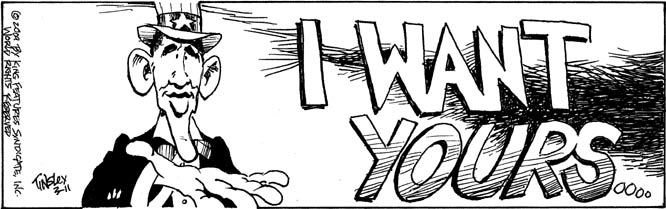
I will post some increases in businesses that will trickle down total increases for the poor and middle-class. In other words, my wife’s check was boosted $26 a month... but all of the following will eat it up:
A must see interview is here:
http://www.cato.org/mediahighlights/index.php?highlight_id=382

Profiting from Obama's Energy Tax Plan
.....It’s not an upfront tax though. That would be too simple and may sound unfair. Even the most ardent tree hugger might consider forcing the oil industry to pay higher tax rates as excessive. That’s why it’s all in the form of increased fees and accounting rules changes.
Included among the proposals to squeeze $30 billion out of the oil industry are:
- Establishing a new excise tax on Gulf of Mexico resources
- Creating new fees for the permitting process of development projects on federal land
- Eliminating tax deductions for repair, site prep, and transportation costs of drilling
There are five or six more changes that will have a significant impact on the domestic oil industry. Each will have price tags of a few hundred million dollars for oil companies. When added all up, the eventual cost is around $30 billion.....
Dan Mitchell Slams Obama Budget Plan

Obama's Budget: Almost $1 Trillion in New Taxes Over Next 10 yrs, Starting 2011
February 26, 2009 12:00 PM
President Obama's budget proposes $989 billion in new taxes over the course of the next 10 years, starting fiscal year 2011, most of which are tax increases on individuals.
1) On people making more than $250,000.
$338 billion - Bush tax cuts expire
$179 billlion - eliminate itemized deduction
$118 billion - capital gains tax hike
Total: $636 billion/10 years
2) Businesses:
$17 billion - Reinstate Superfund taxes
$24 billion - tax carried-interest as income
$5 billion - codify "economic substance doctrine"
$61 billion - repeal LIFO
$210 billion - international enforcement, reform deferral, other tax reform
$4 billion - information reporting for rental payments
$5.3 billion - excise tax on Gulf of Mexico oil and gas
$3.4 billion - repeal expensing of tangible drilling costs
$62 million - repeal deduction for tertiary injectants
$49 million - repeal passive loss exception for working interests in oil and natural gas properties
$13 billion - repeal manufacturing tax deduction for oil and natural gas companies
$1 billion - increase to 7 years geological and geophysical amortization period for independent producers
$882 million - eliminate advanced earned income tax credit
Total: $353 billion/10 years

Glenn [out for blood] Beck: Ben Stein On Cap & Trade Program 3/09
The Obama Tax Plan: Winners and Losers
by Howard Gleckman
This won’t take long. If you are blue-collar wage earner, a low-income family with children, or a college student, you should love President Obama’s tax plan. On the other hand, if you are making more than $250,000, you may not be so happy: By 2011, you'd be paying a lot more tax than you've gotten used to over the past few years.
To the surprise of absolutely nobody, Obama’s budget includes many of the tax changes he promised during the campaign. He’d make permanent many of the “temporary” tax cuts in the just-passed stimulus. Working families would continue to get an $800-a-year tax cut long after the recession ends, and they’d continue to enjoy the benefits of a more generous Earned Income Credit and a more refundable child credit. Obama is proposing tax reductions for low- and moderate-income families of almost $800 billion over the next decade.
But all of this largess will have to be paid for, and Obama has fingered upper-income taxpayers and business. We’ll leave details of the business tax hikes for another day. But the hit on high-income individuals would be pretty hard. The 2001 tax cuts raised after-tax income for those earners in the top one percent by more than 7 percent and for those in the top one-tenth of one percent by 8.4 percent. Under this plan, those days would end. For those who benefited so much from the Bush tax cuts, 2011 would look more like 2000 than 2008.
The pre-2001 tax rates for top-bracket earners would be restored, along with the circa 1990 phase-outs of the personal exemption and the standard deduction. On top of that, Obama has proposed capping the value of all itemized deductions at 28 percent. And, he’d raise the capital gains rate on couples earning $250,000 or more to 20 percent from 15 percent.
It will be a day or so before TPC can model the effect of all this, but the broad outlines are pretty clear. Direct tax increases for individuals making more than $200,000 or couples making more than $250,000: roughly $1 trillion over the next decade. You can add the lion’s share of more than $200 billion in business tax hikes as well, which they’ll end up paying as shareholders.
And that doesn’t include what the wealthy would pay for fossil energy under a cap and trade system for cutting carbon emissions. This is a tax increase in all but name only, and while Obama proposed few details in his budget, a full-blown plan is likely to add up to more than $1 trillion over 10 years. While the president has said the added energy costs would be rebated to low-income families, higher-earners would have to pay out of their own pockets, resulting in yet another tax increase.
In case you hadn’t noticed, the Bush years are definitely over.

Friday, March 13, 2009
Taxin the Poor and Middle-Class

Linda hits an important nail on the head. All the supposed tax breaks and stimulus packages (they aren’t done yet) will disappear with the energy plans that Obama has up his sleeve. My wife's check went up $14 (she gets paid every two weeks). The extra monies in energy and other areas of life are going to put us in the red... especially in California.
Linda Chavez
Friday, March 13, 2009
President Obama reminds me of the fellow who's off to save the world while he ignores the disaster in his own backyard. Instead of focusing on the urgent problems facing the country -- the credit crisis and the collapse of the housing market -- he's diverting scarce resources and attention to solving health care, reforming education, and stopping global climate change. Worse, his efforts to tackle these intractable issues involve fiscal policies that exacerbate the current financial crisis. He is not only driving the deficit up to unsustainable heights, his policies will amount to a huge tax on all Americans.
President Obama claims he's only going to raise taxes on the wealthiest Americans. But even if his tax-the-rich scheme didn't depress investment and slow growth -- which it will -- there are other ways government policies, in effect, tax individuals. Government also imposes tax increases indirectly on individuals through policies that encourage businesses to raise prices paid by everyone.
Most companies operate on relatively thin profit margins; the corporate average has been about 8.5 percent since 1980. Those margins stay relatively constant because capitalism works. If a company's profits get too high, a smart competitor comes in and starts a rival business that makes the same product for less, and the greedy company loses customers.
But what happens when government taxes all businesses -- or even a select group of companies? If the company's profits decline, the company might reasonably respond by laying off workers or reducing capital outlays to cut costs. That's not exactly what we'd like to see at a time of skyrocketing unemployment, declining construction, and decreasing manufacturing orders. The alternative for most businesses is simply to pass on the increased costs to the consumer.
That is exactly what will happen if President Obama's cap-and-trade policy on greenhouse emissions is enacted by Congress. The president wants to impose stricter pollution controls on carbon emissions and allow companies that can't meet those regulations to purchase the right to pollute more through a government auction, with the money flowing into the federal budget.
But how will energy companies pay for what is really a new government tax? By passing it on to their consumers, of course. And unlike other businesses, where competition can help control costs, there isn't much competition in the utilities world. Most of us have few choices when it comes to purchasing electricity or natural gas. We're pretty much captives of our geography, so we won't have a choice about choosing a more efficient, less polluting electricity company if President Obama gets his way on cap-and-trade legislation.
The Congressional Budget Office estimates that cutting carbon emissions by 15 percent would result in a huge cost to most Americans. According to CBO's analysis as reported on the Wall Street Journal editorial page March 9, the plan would cost the bottom 20 percent of households 3.3 percent of their entire after-tax incomes every year, or about $680, while those in the next three quintiles would pay between $880 and $1,500 a year in extra energy costs.
This is exactly the wrong thing to do, and the worst time to do it. The president ought to get over his messiah complex. He's not going to slow the rise of the oceans, as he promised in June when he clinched the Democratic presidential nomination. What the country needs now is not grand schemes to redistribute wealth and provide all Americans cradle-to-grave education and health care at government expense. We don't even need someone to find a way to keep all those homeowners facing foreclosure in their homes. Sadly, the housing bubble has burst and everyone is going to suffer, especially those who couldn't afford the homes they bought in the first place.
What we need now is someone who can figure out what actions the government can and should take to unfreeze credit. If President Obama fixes that, he'll be miracle worker enough.
Monday, March 09, 2009
"Cap & Trade" -- Some Solid Answers Why Not
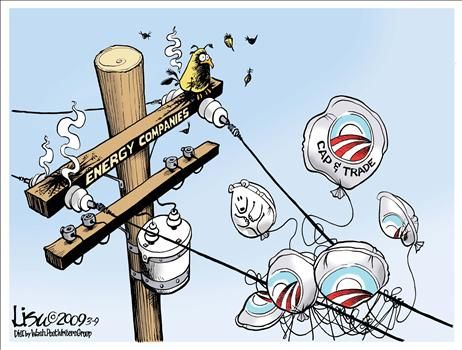
Imported Article, I think this will be one of the “big blows” to our economy and will drive us further into the arms of a more socialist agenda (manufactures for the most part).
By, Rob Jordan
Nancy Pelosi has repeatedly stated that Cap and Trade will be a priority for the 111th Congress. Embraced some years ago in Europe and a few other countries, cap and trade creates an artificial market for various industries to buy, sell, and trade allowances that permit a certain amount of carbon output. It has long been on the wish list for American liberals and extremist environmentalists. And with Democrats now in control of Congress and the White House, you can bet they will soon engage an all effort to enact cap and trade. In fact, in the 2010 White House budget, President Barack Obama calls for a sweeping cap and trade program that would raise $646 billion in new revenues. Here are FreedomWorks’ Top 10 reasons why they shouldn’t…
1. It will raise energy costs: While different nuanced approaches continue to surface, any analysis of any cap and trade scheme comes to the same conclusion; energy costs will go up. The latest serious attempt to enact cap and trade in the United States, America’s Climate Security Act of 2007 sponsored by Sens. Joseph Lieberman (I-CT) and John Warner (R-VA), serves as a good example. An analysis of this legislation cited during a Senate hearing held by the Committee on Environment and Public Works estimated the costs to the average American household would be between $800 and $1,300 by 2015, and then increasing to $1,500 to $2,500 by 2050.
2. It doesn’t help the environment: If energy costs are going to go up for Americans, shouldn’t there be significant environmental benefit and progress towards reversing climate change? You would think so. But even if the most aggressive of cap and trade schemes were properly adhered to, scientists that both advocate and oppose a cap and trade program widely agree that the maximum drop to the earth’s temperature would be no more than 0.07 degrees Celsius by the year 2050. To give some sense of just how negligible this decrease would be, we cannot even estimate the absolute mean surface temperature of the earth within 0.07. What’s worse is that cap and trade actually provides incentives to emit more carbon, not less. An article by the Christian Science Monitor explains: “By turning carbon emissions into commodities that can be bought and sold, cap-and-trade policies could remove the stigma from producing such emissions.” In other words, if industries understand they are working within a legal framework when they output carbon, the public pressure for them to cut down is weakened. Evidence of this can be seen in Europe where most countries have seen carbon emissions go up, even though the European Union has had a cap and trade regime in place since 2005.
3. It doesn’t work where it has been tried: Speaking of Europe, let’s take a closer look at how cap and trade is fairing. As mentioned earlier, the EU is watching carbon emission levels rise despite the fact that they have had a cap and trade system since 2005. Furthermore, the Heartland Institute reports that 12 of the 15 EU nations taking part in the 1997 Kyoto Protocol, a program that sets greenhouse gas reduction targets and serves as a precursor to cap and trade, are failing to meet their reduction targets, with three going over by more than 10 percent and another three going over by more than 20 percent. In fact, emissions for all EU countries went up on average 2.1 percent between 2000 and 2004. Compare this with the United States where currently no such regulatory regime exists and yet emissions went up only 1.3 percent during the same time period. Nonetheless, President Obama has announced an aggressive set of targets for reducing greenhouse gas emissions, promising to “work expeditiously with key stakeholders and the Congress to develop an economy-wide emissions reduction program to reduce greenhouse gas emissions approximately 14 percent below 2005 levels by 2020, and approximately 83 percent below 2005 levels by 2050.”
4. It will cost Americans jobs: This calculation is a pretty simple one. For U.S. industry to comply with a cap and trade scheme, they have to reduce their carbon emissions. There are two ways to do this: (1) produce less – this obviously hurts jobs as companies would seek to streamline their workforce to compensate for a drop in production, or (2) buy carbon allowances in order to keep production up – this, too, would threaten jobs as companies would be forced to devote more internal resources to allowances, negatively effecting their bottom lines and potentially putting workers on the chopping block. In either case, the rising costs of energy under a cap and trade system, as mentioned earlier, only add to the problem. An analysis conducted by Charles River Associates in 2007 estimated anywhere from 1.2 million to 2.3 million jobs would be lost under a cap and trade scheme.
5. It is in effect a hidden regressive tax: We’ve talked about how cap and trade causes energy prices to go up. That doesn’t just hit American industry, but American consumers as well. The Congressional Budget Office (CBO) correctly notes that as these prices go up in the form of higher gasoline, heating oil, and electricity, the poor are hit hardest with what is in effect a hidden regressive tax. President Obama promises to return revenues to vulnerable communities, families and businesses, but that leaves taxpayers at the whim of government to redistribute income rather than letting taxpayer keep their hard earned dollars.
6. It sets a dangerous precedent: While extremist environmentalists and their liberal allies have been whining about climate change for years, most stop short of declaring cap and trade the silver-bullet solution. Environmental groups like the Sierra Club and the National Resources Defense Council are generally supportive of the concept of cap and trade. However, as The Heritage Foundation has pointed out, these groups have found fault with actual proposals such as America’s Climate Security Act of 2007, criticizing them for not going far enough and willing only to endorse them as “a good first step.” As much damage as a cap and trade scheme would cause in its own right, this posture by extreme environmental groups foreshadows even more draconian regulations in our future.
7. It prevents market forces from working for the environment: The market distortions imposed by a cap and trade system would be significant. Recently, major energy companies such as ExxonMobil and Shell have invested hundreds of millions of dollars in technologies that capture and store carbon as well as lower carbon alternative energy sources. A cap and trade system however, sets up perverse incentives that will distract these and other companies from market-based solutions to curb carbon output. Resources instead will be funneled to the artificial market for carbon allowances that cap and trade sets up.
8. It threatens to put the U.S. at a competitive disadvantage with other countries: Though the E.U. and the United States may be buying into cap and trade, industrial giants like China and India are not. Remember the lost jobs we talked about in point #4? In addition to China and India, nearby Mexico (another country where cap and trade is not even a remote possibility) are more than willing to pick up the U.S. slack and bolster their already robust manufacturing sectors.
9. It opens the door to massive fraud and corruption: As energy companies look to game the system, cap and trade would open the door wide for fraud and corruption that could devastate U.S. investors and the economy as a whole. This has been seen already in the UK, a country currently participating in cap and trade. In a recent article by the British-based Guardian newspaper they report: “Britain’s biggest polluting companies are abusing a European emissions trading scheme (ETS) designed to tackle global warming by cashing in their carbon credits in order to bolster ailing balance sheets.” In the United States we have seen what happens when companies engage in creative accounting measures to hide losses and the staggering domino effect it can have on Wall Street investors and the larger economy. If you need more proof of this threat, look no further than this report by The Competitive Enterprise Institute that discusses Enron’s support for a cap and trade scheme that would allow them to dominate this new, made-up market for carbon.
10. It threatens to bust the federal budget at a time when the United States can scarcely afford it: Federal spending continues at a breakneck pace. The recent passage of the trillion-dollar stimulus bill along with even more taxpayer funded bailouts looming on the horizon add to U.S. budget woes and sink us deeper into recession. And as if times weren’t tough enough, the CBO reports that cap and trade would heap additional undue pressure on our fragile budget. According to their report, government would face the same challenges with higher energy costs that consumers do. Additionally, the fall in production for U.S. industry would lead to a loss of federal government tax revenues. Further increasing spending while decreasing revenues makes cap and trade a tough sell in the current economic climate.
Subscribe to:
Posts (Atom)