


Jesus Tomb Documentary – More Flap
Below is an article found in the Jerusalem Post (Jerusalem Post Article Link), I came across it on the Drudge Report. I will link all the articles I came across and posted and commented on – below.
Jesus tomb film scholars backtrack
Etgar Lefkovits, THE
Apr. 11, 2007
Several prominent scholars who were interviewed in a bitterly contested documentary that suggests that Jesus and his family members were buried in a nondescript ancient Jerusalem burial cave have now revised their conclusions, including the statistician who claimed that the odds were 600:1 in favor of the tomb being the family burial cave of Jesus of Nazareth, a new study on the fallout from the popular documentary shows.
The dramatic clarifications, compiled by epigrapher Stephen Pfann of the University of the Holy Land in Jerusalem in a paper titled "Cracks in the Foundation: How the Lost Tomb of Jesus story is losing its scholarly support," come two months after the screening of The Lost Tomb of Christ that attracted widespread public interest, despite the concomitant scholarly ridicule.
The film, made by Oscar-winning director James Cameron and Emmy-winning Canadian filmmaker Simcha Jacobovici, prompted major criticism from both a leading Israeli archeologist involved in the original dig at the site as well as Christian leaders, who were angered over the documentary's contradictions of main tenets of Christianity.
But now, even some of the scholars who were interviewed for and appeared in the film are questioning some of its basic claims.
The most startling change of opinion featured in the 16-page paper is that of
Pfann's paper reported that a statement on the Discovery Channel's Web site, which previously read "a statistical study commissioned by the broadcasters...concludes that the probability factor is 600 to 1 in favor of this being the tomb of Jesus of Nazareth and his family," in keeping with Feuerverger's statement, has been altered and now reads, "a statistical study commissioned by the broadcasters... concludes that the probability factor is in the order of 600 to 1 that an equally 'surprising' cluster of names would arise purely by chance under given assumptions."
Another sentence on the same Web site stating that Feuerverger had concluded it was highly probable that the tomb, located in the southeastern residential
Israeli archeologists have said that the similarity of the names found inscribed on the ossuaries in the cave to the members of Jesus's family was coincidental, since many of those names were commonplace in the first century CE.
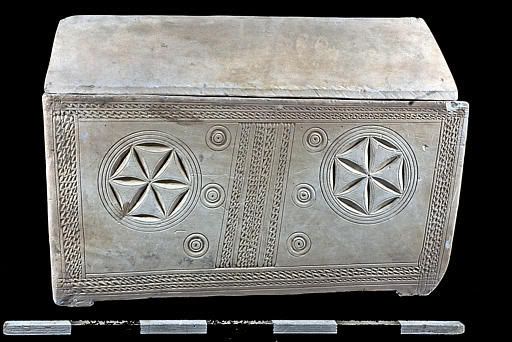
The film argues that 10 ancient ossuaries - burial boxes used to store bones - that were discovered in Talpiot in 1980 contained the bones of Jesus and his family. The filmmakers attempt to explain some of the inscriptions on the ossuaries by suggesting that Jesus was married to Mary Magdalene, and that the couple had a son, Judah.
One of the ossuaries bears an inscription reading "Yeshua son of Yehosef" or "Jesus son of Joseph;" a second reads "Mary;" a third is a Greek inscription apparently read by one scholar as "Mary Magdalene;" while a fourth bears the inscription, "Judah, son of Jesus." The inscriptions are in Hebrew or Aramaic, except for the one in Greek.
But Shimon Gibson, who was part of the team that excavated the tomb two and half decades ago and who appeared in the film, is quoted in Pfann's report as saying he doubted the site was the tomb of Jesus and his family.
"Personally, I'm skeptical that this is the tomb of Jesus and I made this point very clear to the filmmakers," Gibson is quoted as saying.
"We need much more evidence before we can say that the Talpiot tomb might be the family tomb of Jesus," he added.
In the film, renowned epigrapher Prof. Frank Moore Cross, professor emeritus of Hebrew and oriental languages at
"It has been reckoned that 25 percent of feminine names in this period were Maria/Miriam, etc. - that is, variants of 'Mary.' So the cited statistics are unpersuasive. You know the saying: lies, damned lies, and statistics," Cross is quoted as saying.
The paper also notes that DNA scientist Dr. Carney Matheson, who supervised DNA testing carried out for the film from the supposed Jesus and Mary Magdalene ossuaries, and who said in the documentary that "these two individuals, if they were unrelated, would most likely be husband and wife," later said that "the only conclusions we made were that these two sets were not maternally related. To me, it sounds like absolutely nothing."
Furthermore, Pfann also says that a specialist in ancient apocryphal text, Professor Francois Bovon, who is quoted in the film as saying the enigmatic ossuary inscription "Mariamne" is the same woman known as Mary Magdalene - one of the filmmakers' critical arguments - issued a disclaimer stating that he did not believe that "Mariamne" stood for Mary of Magdalene at all.
Pfann has already argued that the controversial inscription does not read "Mariamne" at all.
The burial site, which has been contested from the start by scholars and church officials alike, is some distance from the Church of the Holy Sepulchrr in the
According to the New Testament, Jesus rose from the dead on the third day after his crucifixion, and an ossuary containing Jesus's bones - the explanations of the movie director notwithstanding - would contradict the core Christian belief that he was resurrected and then ascended to heaven.


Just some more articles to read on the “Bones of Jesus.”
Biblical Archaeology Society article
Dr. Gregory Koukl Townhall.com article
another Ben Witherington III blog
The Fruit of Thy Tomb
Discovery Channel’s phony Jesus show.
By John J. Miller
Apparently moviemaker James Cameron wishes he had obtained the film rights to The Da Vinci Code.
What else could explain his association with The Lost Tomb of Jesus? This much-hyped show makes a series of provocative claims about the Christian messiah and his kin: Jesus was betrothed to Mary Magdalene, they had a son named
Yawn. Haven’t we read this novel?
As the mastermind behind
“I think it’s the biggest archaeological story of the century,” Cameron has said of this current project. “It’s absolutely not a publicity stunt.”
No, of course not. That’s why its wild assertions are scheduled for unveiling on a breathless television program rather than in a scholarly journal. We all know that genuine publicity hounds would risk eternal hellfire for the chance to submit an academic paper to a low-circulation quarterly that’s peer reviewed by professional archaeologists and scientists. Television is for losers, right?
Cameron and his director, Simcha Jacobovici, describe The Lost Tomb of Jesus as a documentary. But it’s not. It’s a “documentary” — just as Michael Moore’s Fahrenheit 911 is a “documentary” on the Bush administration. They both actually fall into the genre of conspiratorial advocacy.
At the crux of the program is the assertion that a tomb discovered in
Yet the filmmakers’ methods are highly questionable. Harvard’s Frank Moore Cross, for instance, makes several on-screen appearances, mostly to read the inscriptions on the ossuaries. The presence of Cross, a distinguished scholar at a top-notch university, is meant to provide intellectual heft to the program. Yet Jacobovici merely has him read the words on the ossuaries. As it happens, nobody denies that they carry these names. But are they actually the ossuaries of the son of God and his earthly parents? Jacobovici doesn’t get around to asking Cross, this eminent professor, for an opinion.
So I did. Here’s how Cross replied in an e-mail:
I am skeptical about Jacobovici’s claims, not because of a faulty reading of the ossuary which reads yeshua’ bar yosep [Jesus son of Joseph] I believe, but because the onomasticon [list of proper names] in his period in
For some reason, Cross doesn’t have a chance to say this on camera.
The Lost Tomb of Jesus runs perilously close to Erich von Daniken territory — no prehistoric astronauts, but definitely a flight of fancy. It runs for 90 minutes (with commercials stretching it to two hours). Views that dissent from its relentlessly uncritical presentation of a madly speculative theory — which is to say, the opinions of Cross and virtually every mainstream Biblical scholar who has examined the film’s central contentions — receive almost no air time.
The show tries to dress up its half-cocked conjectures with clips of archaeologists using Q-tips and paint brushes to flick debris from ancient ossuaries. These scenes, which are supposed to convey a sense of authenticity, were almost certainly faked. There’s also a heavyhanded appeal to modern feminism: a reference to how the “male-dominated church” has suppressed the true story of Jesus and his lady love, Mary Magdalene.
Say what you will about Dan Brown, who certainly volunteered a few thoughts about woman-hating Catholics in The Da Vinci Code. At least bookstores continue to stock his novel on their fiction shelves.
Yet The Da Vinci Code and The Lost Tomb of Jesus approach the traditional Christian narrative in essentially the same way: They expose it to a severe, Torquemada-like scrutiny and then propose to replace Western civilization’s foundational story with a newfangled alternative that’s based on a flamboyantly credulous reading of a few cherry-picked Gnostic texts.
It doesn’t take a religious skeptic to understand what this requires: A gigantic leap of faith.
My advice to James Cameron is to quit documentaries and go back to what he does best, which is to make hugely entertaining movies such as True Lies. It turns out that most lies, even when they’re presented as the gospel truth, are in fact false.
"They just want to get money for it"
James Cameron, the Oscar-winning director of "Titanic," has produced a television special that claims to refute the resurrection of Jesus Christ. However, according to archaeologist, Amos Kloner, the first archaeologist to examine the burial site, the idea fails to hold up by archaeological standards, saying, "They just want to get money for it."
Introduction
James Cameron is producing a 90-minute film for the Discovery Channel entitled, "The Lost Tomb of Jesus," claiming that the actual bones of Jesus of Nazareth were buried in a tomb near
The timing of the release
The timing of Discovery's special right before Christianity's Holy Week was not by accident. Last year it was National Geographic's "Gospel of Judas" special on the high Christian holiday of Palm Sunday. One can be certain that the next big "special" will be aired at the same time next year to attempt to discredit Christianity's founder at a time of the year when popular interest focuses on His death and resurrection.
Dating of the bones
It was Jewish custom in the first century A.D., that the bones of the deceased were transferred from burial caves to limestone boxes called ossuaries one year after their death. This practice was abandoned after the destruction of the Jewish Temple in 70 A.D. Frank Moore Cross, a professor emeritus in the Department of Near Eastern Languages and Civilizations at
What was found?
The tomb containing the bones, was first found by a construction crew in 1980 in the
Are the names those of the Holy Family?
Stephen Pfann, a biblical scholar at the University of the
DNA testing
According to the film's website, DNA testing was attempted on only two samples - those of "Jesus" and those of Mariamene. The DNA was so degraded that no sequencing could be determined from the nuclear DNA (the main chromosomes). Only mitochondrial DNA (mtDNA) was available for sequencing. Since mtDNA is much smaller than nuclear DNA, the average person's mtDNA differs from another's by only 8 base pairs. In closely-related communities, differences would be much less. The film's website did not give any details about the testing other than the claim that the individuals "were not related." The Lakehead University Paleo-DNA Laboratory (where the DNA testing was done) has been contacted for additional information. Since "Jesus" and Mariamene were unrelated, the filmmakers assumed they were married and had a son named
Conclusion
Jerusalem-based biblical expert Joe Zias has called the documentary nonsense, saying those involved in the project have "no credibility whatsoever... It's an old story that's been recycled. The story first broke in 1996 by the BBC. It burst in a couple of days." The fact that the inscriptions on the ossuaries date to the beginning of the first century and Jesus and the others died much later, makes it extremely unlikely that "Jeshua" from the "Jesus Tomb" is really Jesus Christ. According to Stephen Pfann, "How possible is it? On a scale of one through 10 - 10 being completely possible - it's probably a one, maybe a one and a half."
What Bones of Jesus?
By Brent Bozell III
… Perhaps the most important debunker is professor Amos Kloner, who oversaw the original archaeological dig of this tomb in 1980. "It makes a great story for a TV film," Kloner told the Jerusalem Post. "But it's completely impossible. It's nonsense."
Joe Zias, who was the curator for anthropology and archeology at the
How do the producers defend themselves against the avalanche of criticism? It's so, so typical. On the "Today" show, Jacobovici and Cameron -- the "Titanic" director -- finally were pressed to respond to critics like Zias. They quickly fell back on the laughable concept that they weren't -- surprise! -- experts. Both said they weren't archaeologists. One insisted he was filmmaker, the other a journalist. Cameron found it "compelling" as a layman.
In other words, neither has credibility -- and neither does the nonfiction Discovery Channel.
When it comes to ancient Christian sites, the Discovery Channel already had a huge credibility problem on its hands. Discovery aired a 2002 special on the alleged "Ossuary of James," which was declared a forgery in 2003 by the Israel Antiquities Authority. Its promoter, Oded Golan, is currently on trial for forging part of the inscription. Jacobovici produced that badly flawed documentary, too.
The Discovery Channel, like most of the national TV elite, displays a dramatic bias in target selection when it comes to religion. There are no controversies over the historical claims of Islam, Judaism or any other religious faith. But Christianity is another story. It is routinely the subject of sensationalistic TV exposes, complete with breathless claims about how Jesus "might be" the son of a Roman soldier, or he might have survived the Crucifixion. And now he's a dad, with kids.
What's worse is that these shoddy alleged exposes always air in the most sacred Christian seasons, like Lent. Last year during Lent, on
If the Discovery Channel fails to cancel this slanderous 'documentary,' it will have to explain why it is intentionally misleading the public. This network should be embarrassed by this plunge into sensational speculation masquerading as 'science.' To slander Christianity at the start of the Lenten season is unconscionable. This isn't news. It's sensationalism on a stick. Or in this case, on a cross.