Showing posts with label Black Republicans. Show all posts
Showing posts with label Black Republicans. Show all posts
Monday, April 26, 2010
Sunday, April 25, 2010
Friday, April 23, 2010
Bob Parks (from Black & Right) Was On Al Sharpton's Radio Show Talking About Tea Parties
Bob Parks was on Al Sharpton's radio program yesterday. Bob was on opposite another guest, Professor Eddie Glaude of Princeton University. The topic was Tea Party "racism." Al Sharpton shows his educational level, and the professor shows his ignorant bias.


Thursday, April 15, 2010
Monday, April 12, 2010
Monday, January 18, 2010
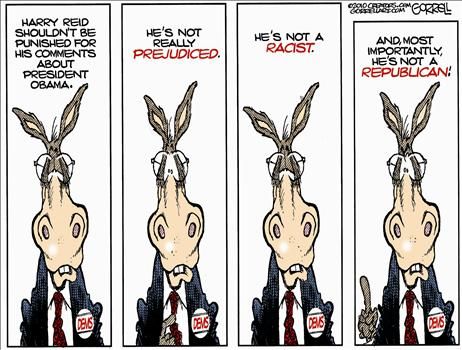
Differing Standards: Dems Can Be Racist, Repubs Cannot (Stephen A Smith calls for Harry Reid to Resign)
What to call black people has to be confusing to white people. Having been around for 73 years, I have been through a number of names. Among the polite ones are: colored, Negro, Afro-American, black, and now African-American. Among those names, African-American is probably the most unintelligent. You say, "What do you mean, Williams?" Suppose I told you that I had a European-American friend or a South-America-American friend, or a North-America-American friend. You'd probably say, "Williams, that's stupid. Europe, South America and North America are continents consisting of many peoples." You might insist that I call my friend from Germany a German-American instead of European-American and my friend from Brazil a Brazilian-American rather than a South-America-American and my friend from Canada a Canadian-American instead of a North-American. So would not the same apply to people whose heritage lies on the African continent? For example, instead of claiming that President Barack Obama is the first African-American president, it should be that he's the first Kenyan-American president. In that sense, Obama is lucky. Unlike most American blacks, he knows his national heritage; the closest to a national heritage the rest of us can identify is some country along Africa's gold coast.
Another problem with the African-American label is not all people of African ancestry are dark. Whites are roughly 10 percent of Africa's population and include not only European settlers but Arabs and Berbers as well. So is an Afrikaner who becomes a U.S. citizen a part of United States' African-American population? Should census takers and affirmative action/diversity bean counters count Arabs, Berbers and Afrikaners who are U.S. citizens as African-Americans and should they be eligible for racial quotas in college admittance and employment?
Are black Americans a minority group? When one uses the term minority, there is an inference that somewhere out there is a majority but in the United States we are a nation of minorities. According to the U.S. Census Bureau 2000 census, where people self-identify, the ancestry of our largest ethnic groups are people of German ancestry (15.2 percent), followed by Irish (10.8 percent), African (8.8), and English (8.7) ancestry. Of the 92 ethnic groups listed, in the census, 75 of them are less than 1 percent of our population.
Race talk often portrays black Americans as downtrodden and deserving of white people's help and sympathy. That vision is an insult of major proportions. As a group, black Americans have made some of the greatest gains, over the highest hurdles, in the shortest span of time than any other racial group in mankind's history. This unprecedented progress can be seen through several measures. If one were to total black earnings, and consider black Americans a separate nation, he would find that in 2005 black Americans earned $644 billion, making them the world's 16th richest nation -- that is just behind Australia but ahead of Netherlands, Belgium and Switzerland. Black Americans are, and have been, chief executives of some of the world's largest and richest cities such as New York, Chicago, Los Angeles, Philadelphia and Washington, D.C. It was a black American, Gen. Colin Powell, appointed Joint Chief of Staff in October 1989, who headed the world's mightiest military and later became U.S. Secretary of State, and was succeeded by Condoleezza Rice, another black American. Black Americans are among the world's most famous personalities and a few are among the richest. Most blacks are not poor but middle class.
On the eve of the Civil War, neither a slave nor a slave owner would have believed these gains possible in less than a mere century and a half, if ever. That progress speaks well not only of the sacrifices and intestinal fortitude of a people; it also speaks well of a nation in which these gains were possible. These gains would not have been possible anywhere else.
Thomas Sowell
March 18, 2002
Did anyone ever call Franklin D. Roosevelt a "Dutch American" or Dwight Eisenhower a "German American"? It would have been resented, not only by them and their supporters, but by Americans in general. These men were Americans -- not hyphenated Americans or half Americans.
Most black families in the United States today have been here longer than most white families. No one except the American Indians can claim to have been on American soil longer. Why then call blacks in the United States "African Americans," when not even their great-great-great-grandparents ever laid eyes on Africa?
It is certainly understandable that activists, politicians and others who wish to divide Americans for their own purposes would push the notion of "African Americans." They also push such things as the "African" holiday Kwanzaa -- which originated in Los Angeles -- and "black English" or "ebonics," which originated centuries ago in particular localities in Britain, and is wholly unknown in Africa.
Names are just part of the process of creating wholesale frauds about the past, in order to advance special agendas in the present. Personal names are also part of that fraud.
The vogue of repudiating black family names that supposedly were given by slaveowners in times past is another reflection of the widespread ignorance of history among Americans in general, as a result of our dumbed-down education. Slaves were not only not given family names, they were forbidden to have family names.
In many parts of the world, family names began with the elites, and only over the centuries moved down the social scale until ordinary people were allowed to have them. In England, common people began to have family names only after the Middle Ages, and in Japan it was the late 19th century before commoners could use family names. It was the 20th century before ordinary people in Iran were allowed -- and directed -- to have family names.
Slaveowners in the American antebellum South were especially opposed to slaves having family names because such names emphasized family ties -- and the only legally recognized tie of a slave was to his owner, who could sell him miles away from his kin.
The slaves themselves, however, used family names to create a sense of family, though they were careful not to use these names around whites. Even after Emancipation, blacks who had been raised in slavery often hesitated when some white person asked them their family name.
The so-called "slave names" that so many blacks began repudiating in the 1960s, were neither given to them by slaveowners nor were they usually the slaveowners' family names. They were names chosen despite prohibitions, in order to symbolize family ties that were often stronger than those in today's ghettoes.
The late Herbert Gutman -- a tough-minded historian -- was once on the verge of tears as he described the desperate efforts of blacks in the years after Emancipation to try to find family members who had been sold, sometimes hundreds of miles away. These poor and illiterate people would find somebody who could read and write, who would write what were called "inquiring letters" to black churches in the South. In these churches, someone would then read these letters aloud to the congregations, asking if anybody who knew anything about the person being sought would speak up, so that this family could be reunited again.
Those who try to claim that the shattered families in today's ghettoes are "a legacy of slavery" ignore the fact that, a hundred years ago, a slightly higher percentage of blacks than of whites were married and most black children were raised in two-parent families, even during the era of slavery.
As late as 1950, a higher percentage of black women than of white women were married. The broken families of today are a legacy of our own times and our own ill-advised notions and policies.
Of all the reactions against the supposed "slave names" among blacks, the most painfully ironic has been the taking of Arab names instead. The Arabs engaged in massive enslavement of Africans before the Europeans began to -- and continued long after the Europeans stopped.
One of the many reasons for studying history is to prevent history from being misused for current hidden agendas. Names are just one of the things being misused in thisway.
Thursday, January 07, 2010
Friday, October 30, 2009

Friday, October 23, 2009
Abortion Kills More Black Americans Than the Seven Leading Causes of Death Combined, Says CDC Data

(Tank2 h/t-import)
Friday, October 23, 2009
Should See My: "Margaret Sanger and the Racist History of Planned Parenthood (Black Genocide)"
Friday, October 23, 2009
Should See My: "Margaret Sanger and the Racist History of Planned Parenthood (Black Genocide)"
(CNSNews.com) – Abortion kills more black Americans than the seven leading causes of death combined, according to data collected by the Centers for Disease Control and Prevention for 2005, the latest year for which the abortion numbers are available.
Abortion killed at least 203,991 blacks in the 36 states and two citie More..s (New York City and the District of Columbia) that reported abortions by race in 2005, according to the CDC. During that same year, according to the CDC, a total of 198,385 blacks nationwide died from heart disease, cancer, strokes, accidents, diabetes, homicide, and chronic lower respiratory diseases combined. These were the seven leading causes of death for black Americans that year.
A total of 49 jurisdictions reported their abortion numbers for 2005 to the CDC. These included all 50 states--except California, Louisiana, and New Hampshire--and New York City and the District of Columbia. Of these 49 jurisdiction, only 36 states plus New York City and the District of Columbia reported the number of abortions by race.
Of these 36 states, Georgia reported the largest number of abortions--18,325--among African Americans. Idaho and Montana reported the fewest, 16 and 17 respectively.
Among the large states not reporting abortions by race--and thus where the number of blacks killed by abortions is not included in the national total of 203,991--are California, Florida, Illinois and the rest of New York state outside of New York City.
According to the CDC, the total of 203,991 blacks killed by abortion in 2005 also does not include those aborted by "private physicians’ procedures.”
Every year since 1969, the CDC has amassed abortion data by state or area of occurrence, requesting information each year from the 50 states, the District of Columbia, and New York City. The CDC attempts to collect data on abortions by the age, race and marital status of the women who undergo them as well as the type of abortion procedure.
However, the “CDC is not a regulatory agency,” Senior Press Officer Karen Hunter told CNSNews.com. “So while we are required by Congress to collect this information, states are not required to provide any data to the CDC, including abortion surveillance.”
In 2005, a total of 820,151 legal abortions were performed in the 49 jurisdication that reported abortions to the CDC, according to the “Abortion Surveillance” report, which is published in the CDC's Morbidity and Mortality Weekly Report, or MMWR, for Nov. 28, 2008. (Scroll up to top of report)
The report states, “Approximately 1 in 5 U.S. pregnancies have ended in abortion,” and also notes some limitations on the data: “The overall number, ratio, and rate of abortions are conservative estimates; the total numbers of legal induced abortions provided by central health agencies and reported to the CDC for 2005 were probably lower than the numbers actually performed.”
In Table 9 of the report, it states that there were 203,991 blacks killed by abortion, which comprises 35.5 percent of all abortions reported for that year.
Rev. Clenard H. Childress, Jr., founder of BlackGenocide.org, told CNSNews.com that according to numbers gleaned from statistics provided by the Guttmacher Institute, a pro-abortion group, 1,784 blacks are aborted each day. Also, he notes on his Web site that three out of five African-American women will obtain an abortion.
Childress said the information and sources on his Web site have never been challenged by abortion-access supporters. “This is because they can see that themselves, and they know them probably to be far worse than we’re reporting. The facts come from the pro-abort/pro-choice community,” he said.
“You want to go to a reliable source where people can’t dismiss what you’re saying,” Childress said.
“Yet the Congressional Black Caucus, NAACP, Urban League, and the National Action Committee of Al Sharpton fail abysmally to report not only the decimation but the health ramifications which are questionably very pertinent and provable,” said Childress.
“It would be one thing if we were talking about something hypothetically, but these are actual empirical proofs. … We simply want the health issues of abortion to be discussed,” Childress added.
Susan Cohen, director of government affairs at the Guttmacher Institute, said that black women are not inordinately targeted.
It is the high number of unintended pregnancies among black women that explains the disproportionate number of black abortions, she stated in a policy analysis, “Abortion and Women of Color: The Bigger Picture (2008),” which was provided to CNSNews.com by Guttmacher Institute spokeswoman Rebecca Wind.
While acknowledging that the abortion rate for blacks in the United States is “almost 5 times that for white women,” Cohen concluded in her analysis, “these higher unintended pregnancy rates (among African American women) reflect the particular difficulties that many women in minority communities face in accessing high-quality contraceptive services and in using their chosen method of birth control consistently and effectively over long periods of time."
“Because black women experience so many more unintended pregnancies than any other group—sharply disproportionate to their numbers in the general population—they are more likely to seek out and obtain abortion services than any other group,” said Cohen.
When asked to comment on this report, Dr. Freda Bush, an obstetrician and gynecologist in private practice in Jackson, Miss., told CNSNews.com that she found the explanation for the high rate of black abortions “disingenuous.”
“I would just like for them to explain why there’s such a significant proportion of their clinics that are located in minority communities,” said Bush, who is black. “So if you’ll notice, I did not mention that as a factor when I talked to you [earlier], so I was not accusing them of anything.
“I was just pointing out the fact that we have more, but since they brought it up, I would like for them to explain where their clinics are located, and why their clinics are located in that area,” she added.
“I would also like for an explanation of why their founder, Margaret Sanger, who was a known eugenist, also had a Negro project, and an explanation if that was not directed at the ‘undesirables,’” said Bush. “So, I’m not accusing them of anything. I would just like an explanation for the practices that they have continued.”
Dr. Alveda King, niece of slain civil rights leader Dr. Martin Luther King Jr., is a pro-life activist. In August 2007 she told a meeting of Priests for Life that abortionists “plant their killing centers in minority neighborhoods and prey upon women who think they have no hope.”
“The great irony,” she said, “is that abortion has done what the Klan only dreamed of.


Wednesday, August 05, 2009
The "White" Party??
Huffington Post bemoans the new emerging "White Party" known as the GOP


Great Black Patriots From American History (Part 1)
From Bondage To the Halls of Congress (Part 2)
The Civil Rights Movement (Part 3)
From Bondage To the Halls of Congress (Part 2)
The Civil Rights Movement (Part 3)
The entire DVD American Heritage Series come highly recommended. As well as the book and extended DVD documentary entitled, "American History in Black & Whilte." Really, all Barton's products are top-notch!
Black history month doesn't include these inspiring stories from our (U.S.) history. This is a second part to a three-part series about true history and it is a powerful comment on what is not told our kids and university students -- for obvious reasons.
Sunday, July 26, 2009
Conservative Black Woman's Take On Gates/Crowley
The Self Described Blackest Man On The Internet Calls Out "Skip" Gates On His High Profile "Bitch-Assness" (my words not his)
Blogger under the alias Denmark Vesey who describes himself as "the blackest man on the internet" says the following regarding Professor Gates:
No. It is because you are a Plantation Negro in a white neighborhood."
Dang....I couldn't have said it better myself. He goes on to say in comments and this is just beautiful....
"Gates is making a bitch move by implying his actions had nothing to do with what happened and that it was strictly a function of his skin color.Ya'll Plantation Negros still think "blackness" is a game of mindless group identity victim politics.When bad shit happens "Itz Cuz Iz Bwak!"
"If you call yourself "Skip",
If you marry a woman who looks like Edith Bunker,
If your claim to fame is to have been allowed to work at Harvard,
If you are known as a preeminent black scholar and writer but no black people can quote you,
If you identify yourself as "Half-white",
If you identify your children as "Half-white",
If you are proud of the fact you live in a "white" neighborhood,
If when you move into a new house you report to the local precinct to introduce yourself to the police ...The first time a police officer upsets you - You Cannot Yell "It's Because I'm A Black Man In America!"
No. It is because you are a Plantation Negro in a white neighborhood."
Dang....I couldn't have said it better myself. He goes on to say in comments and this is just beautiful....
"Gates is making a bitch move by implying his actions had nothing to do with what happened and that it was strictly a function of his skin color.Ya'll Plantation Negros still think "blackness" is a game of mindless group identity victim politics.When bad shit happens "Itz Cuz Iz Bwak!"
Sunday, July 19, 2009


Thursday, July 16, 2009
Senator Boxer Tries the Race Card, Black Chamber of Commerce, President and CEO Harry Alford Shuts Her Down
This is classic because the Democrats expect all minority persons to "fall in line" in regards to the Party line. If they do not, typically they are maligned and besmirched... one only need recall the Left's tolerance (quoting a poster at Politico, "mkat33"):
Enjoy... I did:
when the left attacked Clarence Thomas, why wasn't that about race? When the left attacked Alberto Gonzales, why wasn't that about race? When the left attacked Sarah Palin, why wasn't that about gender? You may think that those on the right are the haters, but I guarantee you'll never see a "Sonia Sotomayor is a C***" t-shirt. Sure, the Democrats have a bigger tent, but that's only to allow them to fit the hordes of intolerant stooges that blindly follow the left's politics of hate.
UPDATE: Harry Alford goes there on John Ziegler's radio show today. Alford blasts Barbara Boxer for the way she treated him during a Senate committee hearing, calling her a racist and accusing her of treating him "like an ignorant jigaboo up there."
Wednesday, July 15, 2009
The Black Sphere's New Book
 I wrote this awhile back for American Thinker, and decided that for the 4th of July I should post it here. It is written much like parts of my new book The BIG Black Lie, so I hope you enjoy it.
 I received an email from a black man who was attempting to convince me that, though I am completely black, I have no experience growing up black in America. The bulk of his theory on my ‘blackness' was based on the fact that I constantly lampoon Obama in my blog. He counseled me to embrace Obama, as Obama could help me to "rediscover the black experience." He warned that "whites would never see me, as I see me."
Touting Obama as the poster child for blackness is a ridiculous notion. Further, the idea that Obama can teach me "blackness" is equally ridiculous. Unlike me, Obama is only half-black -- as much white, as he is black. Obama's formative years were spent mostly in the white world. He was raised by his white grandparents in upper middle-class lifestyle. He attended expensive mostly white private schools in his youth, his education culminating with Harvard. Read more...
Thursday, July 02, 2009
Friday, May 22, 2009
Some Important Links (Busting the Racial Myths)

- Great Black Patriots From American History
(Part 1) - From Bondage To the Halls of Congress
(Part 2) - The Civil Rights Movement
(Part 3) - Thomas Sowell Talking About Diversity and Equality
- Larry Elder Debating Racism on the Tavis Smiley Show
- Black Urban Myths
- "ObamaCon" - Papa Giorgio (Me) on Obama's Racist/Liberation Church he Attended for 20-years

Saturday, May 16, 2009
Wednesday, April 22, 2009
A "Black Man" Comments on "White Power" Comment by Garofalo
This is a HotAir h/t. MachoSauce at a Tea Party.
And has the crowd eating out of his hand. It’s Zo, on the scene in Sacramento to cover the party for PJTV and recruited at the last minute to say a few words to the throng, the missing teleprompter notwithstanding. He specifically asked that people post this clip as a rebuke to Janeane Garofalo, which I’m happy to do — although he’s kidding himself if he thinks it’ll change anything. She’s already weighed in on black conservatives. How do you sleep at night, race traitor?
Monday, March 09, 2009
Walter Williams on Health-Care
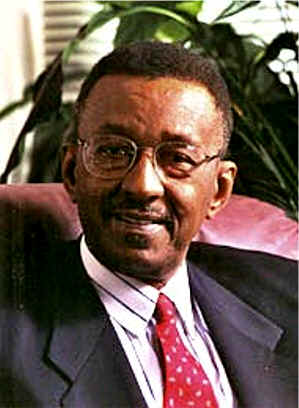
This -- likewise -- is an important article to read about comparing health-care to that of other countries. The video at the end connects well with the following articles:
Sweden's Government Health Care
Walter E. Williams
Wednesday, March 04, 2009
Government health care advocates used to sing the praises of Britain's National Health Service (NHS). That's until its poor delivery of health care services became known. A recent study by David Green and Laura Casper, "Delay, Denial and Dilution," written for the London-based Institute of Economic Affairs, concludes that the NHS health care services are just about the worst in the developed world. The head of the World Health Organization calculated that Britain has as many as 25,000 unnecessary cancer deaths a year because of under-provision of care. Twelve percent of specialists surveyed admitted refusing kidney dialysis to patients suffering from kidney failure because of limits on cash. Waiting lists for medical treatment have become so long that there are now "waiting lists" for the waiting list.
Government health care advocates sing the praises of Canada's single-payer system. Canada's government system isn't that different from Britain's. For example, after a Canadian has been referred to a specialist, the waiting list for gynecological surgery is four to 12 weeks, cataract removal 12 to 18 weeks, tonsillectomy three to 36 weeks and neurosurgery five to 30 weeks. Toronto-area hospitals, concerned about lawsuits, ask patients to sign a legal release accepting that while delays in treatment may jeopardize their health, they nevertheless hold the hospital blameless. Canadians have an option Britainers don't: close proximity of American hospitals. In fact, the Canadian government spends over $1 billion each year for Canadians to receive medical treatment in our country. I wonder how much money the U.S. government spends for Americans to be treated in Canada.
"OK, Williams," you say, "Sweden is the world's socialist wonder." Sven R. Larson tells about some of Sweden's problems in "Lesson from Sweden's Universal Health System: Tales from the Health-care Crypt," published in the Journal of American Physicians and Surgeons (Spring 2008). Mr. D., a Gothenburg multiple sclerosis patient, was prescribed a new drug. His doctor's request was denied because the drug was 33 percent more expensive than the older medicine. Mr. D. offered to pay for the medicine himself but was prevented from doing so. The bureaucrats said it would set a bad precedent and lead to unequal access to medicine.
Malmo, with its 280,000 residents, is Sweden's third-largest city. To see a physician, a patient must go to one of two local clinics before they can see a specialist. The clinics have security guards to keep patients from getting unruly as they wait hours to see a doctor. The guards also prevent new patients from entering the clinic when the waiting room is considered full. Uppsala, a city with 200,000 people, has only one specialist in mammography. Sweden's National Cancer Foundation reports that in a few years most Swedish women will not have access to mammography.
Dr. Olle Stendahl, a professor of medicine at Linkoping University, pointed out a side effect of government-run medicine: its impact on innovation. He said, "In our budget-government health care there is no room for curious, young physicians and other professionals to challenge established views. New knowledge is not attractive but typically considered a problem (that brings) increased costs and disturbances in today's slimmed-down health care."
These are just a few of the problems of Sweden's single-payer government-run health care system. I wonder how many Americans would like a system that would, as in the case of Mr. D. of Gothenburg, prohibit private purchase of your own medicine if the government refused paying. We have problems in our health care system but most of them are a result of too much government. Over 50 percent of health care expenditures in our country are made by government. Government health care advocates might say that they will avoid the horrors of other government-run systems. Don't believe them.
The American Association of Physicians and Surgeons, who published Sven Larson's paper, is a group of liberty-oriented doctors and health care practitioners who haven't sold their members down the socialist river as have other medical associations. They deserve our thanks for being a major player in the '90s defeat of "Hillary care."
Subscribe to:
Posts (Atom)