No single topic drives the health care reform debate like the number of uninsured Americans, variously numbered in speeches and ads at 45 million, 46 million, 47 million, or even 50 million. Unfortunately, most of what we think we know about the un insured is wrong.
For the record, according to the latest figures from the Census Bureau, 45.6 million Americans currently lack health insurance. This is actually down slightly from the 47 million that were uninsured in 2006. However, those numbers don't tell the whole story.
For example, roughly one quarter of those counted as uninsured — 12 million people — are eligible for Medicaid and the State Children's Health Insurance Program (S-CHIP), but haven't enrolled. This includes 64 percent of all uninsured children, and 29 percent of parents with children. Since these people would be enrolled in those programs automatically if they went to the hospital for care, calling them uninsured is really a smokescreen.
Another 10 million uninsured "Americans" are, at least technically, not Americans. Approximately 5.6 million are illegal immigrants, and another 4.4 million are legal immigrants but not citizens.
The reality is that most people without health insurance are uninsured for a relatively short period of time.
Nor are the uninsured necessarily poor. A new study by June O'Neill, former director of the Congressional Budget Office, found that 43 percent of the uninsured have incomes higher than 250 percent of the poverty level ($55,125 for a family of four). And slightly more than a third have incomes in excess of $66,000. A second study, by Mark Pauly of the University of Pennsylvania and Kate Bundorf of Stanford, concluded that nearly three-quarters of the uninsured could afford coverage but chose not to purchase it.
And most of the uninsured are young and in good health. According to the CBO, roughly 60 percent are under the age of 35, and fully 86 percent report that they are in good or excellent health.
Finally, when we hear about 45 million Americans without health insurance, it conjures up the notion that all of those are born without health insurance, die without health insurance, and are never insured in between. The reality is that most people without health insurance are uninsured for a relatively short period of time.
Only about 30 percent of the uninsured remain so for more than a year, approximately 16 percent for two years, and less than 2.5 percent for three years or longer. About half are uninsured for six months or less. Notably, because health insurance is too often tied to employment, the working poor who cycle in and out of the job market also cycle in and out of health insurance....
An editorial in the July-August 2009 AARP Bulletin repeats the same bromide heard almost nightly on the MSM news: That there are currently 47 million Americans without health insurance. The AARP editorial goes on to argue that this situation is disgraceful; that all Americans should have "affordable health care choices"; and that in terms of reform, "the time to act is now."
The sad tale of the 47 million uninsured is, perhaps, the most emotionally persuasive argument put forth for national health care reform. But is the alleged number of uninsured reasonably accurate? Or is it, instead, a purposely misleading statistic designed to advance a specific reform agenda?
The 47 million uninsured number is generated by an annual U.S. Census Bureau report. However, that report also states that the 47 million uninsured includes roughly 10 million illegal aliens without health insurance. Thus, if we subtract out the illegals, the number of uninsured American citizens without health insurance declines by more than 20%...to roughly 37 million.
But is it accurate to assume that even 37 million Americans cannot afford health insurance? Absolutely NOT. Even Hillary Clinton during her presidential campaign once admitted that 25% of the uninsured could afford health insurance but chose not to purchase it. The Census Bureau reports that there are roughly 17 million people who make more than $50,000 per year and who, for whatever reason, decide not to carry health insurance.
In short, with two reasonable adjustments, the number of Americans who cannot afford health insurance has been reduced from 47 million to approximately 20 million.
But is the 20 million figure itself reasonably accurate? Probably not. Individuals moving between jobs lose their (employer provided) health insurance and when they do the Census Bureau counts them as "uninsured." Technically true. Yet during normal times, roughly half of these individuals will have re-acquired (in about 4 months) health insurance coverage with a new employer.
Finally, there are millions of adult Americans and children who have (nearly free) access to medical care benefits through Medicaid and other government programs who don't really need the direct cost of "insurance" and who don’t carry any.
Thus, with reasonable adjustments, there are in fact less than 10 million individuals who are so-called "chronically uninsured." (The Kaiser Family Foundation says the number could be as low as 8 million). These are individuals who have been unemployed for over 2 years and/or people from households that are too poor to afford non-employer health insurance premiums and who, for whatever reason, have limited access to taxpayer-supported health services.
So let’s grant that there are between 8 to 10 million Americans (total population: 307 million) who cannot afford health insurance and that this situation may require a marginal public policy adjustment. (Most states mandate expensive benefit coverage; curtailing those mandates would lower the cost of health insurance.) But whether that situation requires some massive, Washington D.C. health care reform – with new regulations and mandates on health care providers, insurance companies, and drug manufacturers – is entirely problematic.
Politicians and interest groups, eager to remake your medical world over to their liking, would do well to respect the Hippocratic oath administered to physicians: “First, do no harm.”
Excerpted from a small debate I was in elsewhere on the web:
...the stat you quoted (Obama and others) are 46-million uninsured. This number has been debunked by a few sources. Census date and other studies. 18.3 million of this number, for instance, are under 34 and voluntarily opt out of health care because they believe themselves to be young and healthy. BlueCross did a study that show in actuality only 8.2 million people are actually uninsured that want insurance but cannot pay for it. A number that Republican plans deal with by-the-by. But when you have no Republicans voting for a bill like this and 34 Democrats voting against it with Republicans, there is a unanimity (bipartisanship), just not the way Democrats wished to highlite. These numbers remind me of the stats used by Clinton and then later Kerry that said a woman makes 70-cents and 73-cents (respectively) to every man's dollar, or Michael Moore stating that 44-million Americans are illiterate -- Respectively:
This is another myth buster. It is in fact an update to a well-known myth... that Republicans are the party for the rich and Democrats are the party for the poor. You also must come to the conclusion as well that all those "tax-loopholes" that these rich Dems speak about in an ominousness tone that they must overcome in order to bilk the rich of their tax returns, that they themselves are using as well. Come on. Who's first (and keep in mind he wasn't intelligent enough, hard-working enough, or entrepreneurial enough to earn this... he married into it?)
1. Sen. John Kerry (D-Mass.) $167.55 million
Kerry once again ranks atop the 50 Richest Members of Congress, even as his financial disclosures show his reported holdings shrank by 28 percent in 2008.
The Massachusetts Senator reported a reduction of more than $64 million from his coffers, including the sale of a “Heinz Family Commingled Stock Fund” valued at $22.3 million in the previous year. Kerry also increased his debts to a total of $47.86 million with the addition of four new liabilities worth more than $1 million each.
Since the bulk of Kerry’s wealth is actually his wife’s money, he has dozens of assets listed as simply “over $1 million,” the category reserved for spouse assets. But even the lack of detail provides some hint of the losses: In 2007 Kerry reported more than 180 of these “over $1 million accounts”; in 2008 there were only about 130
The first post is from Rush, the second is a compilation by me and involved an encounter with a guy on the golf-course.
Democrats Get More Money From "Rich"
Another myth about "the rich" has been shattered – namely the conventional wisdom that they are all Republicans – thanks to the nonpartisan Center for Responsive Politics. A December 18, 2002 Washington Times editorial reports that donors giving "small and medium amounts" in 2002 overwhelmingly supported the GOP, while "rich or deep-pocketed givers" hugely backed the Democrats!
Those giving $200 to $999: GOP $68 million; Democrats $44 million. Those giving $1,000 to $9,999: GOP $317 million; Democrats $307 million. The "fabulously wealthy" donors of $10,000+ gave $111 million to the GOP – a whopping $29 million less than the $140 million they lavished on the Democrats! Among those who gave $100,000+, the Democrats raised $72 million – more than double the $34 million the GOP took.
"Yeah, Rush, but all those millionaires are Republicans." No, that's not a fact, my friends. The fact is that in the 2002 election cycle, those who gave a million dollars or more poured $36 million into the Democrat coffers, and a paltry $3 million into the pockets of the GOP. Again: millionaire donations went Democrat by a 12:1 margin! The two parties took in about the same amount overall – GOP: $384 million; Democrats: $350 million. Just look at the Hollywood left, and you see where the big money goes.
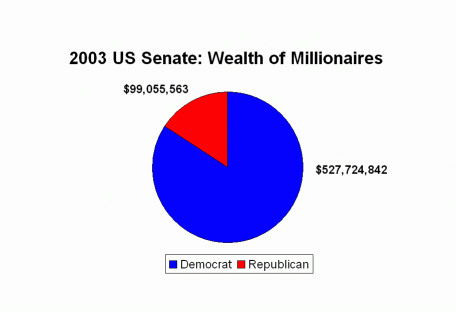
In addition, the GOP attracted 40% more individual donors! (George W. Bush set an all-time fund-raising record by collecting the most money from one-thousand-dollar donors in the history of presidential politics.) Far more people giving small amounts exist as contributors to the Republican Party - while Democrats skunked the GOP among the super-rich. That's no surprise, since nine of the twelve richest members of the United States Senate are Democrats.
We're going to put this up on our website homepage permanently, right alongside the story that the top 50% of wage earners, those who make more than $26,000 a year, pay over 96% of all income taxes. (The IRS data) This myth that the Republicans are the party of the rich is breathing its last gasps, so we're giving you these figures to help put it out of its misery for good. This is not a political commercial you have to disprove. These are actual results of campaign contributions in just the 2002 cycle, which is why this class-envy garbage isn't getting the traction it used to.
Greedy Religious Conservatives!
(A debate from 2004 I had)
I wanted to isolate a previous discussion and get some of your input on us greedy conservatives. The only reason I bring this up is that while playing golf in Vegas I got into a discussion with one of the caddies about politics and faith. The conversation started out very interestingly though. Democrats/Liberals place a lot of emphasis on feelings in their anti-Bush diatribe. This elderly caddy maybe in his mid-fifties said he wouldnt vote for bush because his wife worked for the phone company making good money for fifteen-years. She lost her job and is now a receptionist for a Veterinarian. He said, I wont vote for that assho#@!& because my wife isn’t making any money!! I pointed out, politely, so as to not make him explode, that it is not Bushs fault that his wife does not have a degree or a specialty that can get them by in these lean times. He realized that his wifes life choices put them in the spot their in, not Bush (with a little coaxing from me of course). So I explained some of the following during our conversation, passerbys stopping and patting me on the back for such a great example of conservatisms values at work.
If you can remember back to the 2000 election here in the U. S. and the blue state, red state scenario of which voted for Gore and which voted for Bush, Im sure you do, even if another country. Once in awhile stats are done to see which part of the country (which states in fact) give more to charity per-capita than other states. Do you know which of the top twenty states gives the most to charity? You got it, Bush country! Every single one of the red states in that top-twenty are the middle-income fly-over states. Guess how many red-states got the lower twenty of giving? Two. Eighteen States that were in the lowest giving ratio to charity were Gore states. This is even more interesting with a few recent poles. Just under 66-percent republicans go to church one-to-two times a week. Just fewer than 66-percent democrats do not even go to church once a week. DRAT those nasty religious / conservatives!
New Stat that I am adding to my arguments by the way:
Only one of the top 25 donors to political 527 groups has given to a conservative organization, shedding further light on the huge disparity between Democrats and Republicans in this new fund-raising area.The top three 527 donors so far in the 2004 election cycle - Hollywood producer Steven Bing, Progressive Corp. chairman Peter Lewis and financier George Soros - have combined to give nearly $24 million to prominent liberal groups. They include Joint Victory Campaign 2004, America Coming Together, and MoveOn.org.
Dems the richest five senators?
Financial statements revealed the five richest members of the United States Senate are Democrats. The annual disclosure allows senators to represent their net worth inside a broad range.
Presidential candidate Sen. John Kerry (D-MA) is far ahead of his colleagues with $163 million, most of it coming from his wife's inheritance of the Heinz fortune. The actual estimate is over $400 million.
Lagging behind is Sen. Herb Kohl (D-WI) at $111 million. The Wisconsin senator's family owns a department store chain. Sen. John "Jay" Rockefeller (D-WV) comes in third with a personal fortune reported to be $81 million.
Former Goldman Sachs chairman Sen. John Corzine (D-NJ) weighs in at $71 million, with Sen. Diane Feinstein (D-CA) rounding out the top five at $26.3 million. Sen. Peter Fitzgerald (R-IL) breaks the string of Democrat multimillionaires in sixth place at $26.1 million. Sens. Frank Lautenberg (D-NJ), Bill Frist (R-TN), John Edwards (D-NC), and Edward Kennedy (D-MA) complete the top ten.
Democrats are 10 of the top 15 richest senators.
--RE-POST 2--
From a discussion elsewhere
Okay, let's move on.Another point that needs setting straight is when Jen says "the rich are getting richer and the poor are getting poorer."Again, these bumper-sticker slogans are great if one just wishes to construct false claims for the express purpose of rejecting one political party for another.This phrase may seem right, like one I hear all the time, "the New Testament has been changed over the past 2,000-years," it has a ring of truth to it. . . but just like the political statement that preceded it, when one studies the facts, it just doesn't hold any water.
The Top 50% pay 96.54% of All Income Taxes
(The top 1% pay more than a third: 34.27%)
October 4, 2005
This is the latest data for calendar year 2003 just released in October 2005 by the Internal Revenue Service. The share of total income taxes paid by the top 1% of wage earners rose to 34.27% from 33.71% in 2002. Their income share (not just wages) rose from 16.12% to 16.77%. However, their average tax rate actually dropped from 27.25% down to 24.31%
*Data covers calendar year 2003, not fiscal year 2003 - and includes all income, not just wages, excluding Social Security
Think of it this way: less than 3-1/2 dollars out of every $100 paid in income taxes in the United States is paid by someone in the bottom 50% of wage earners. Are the top half millionaires? Noooo, more like "thousandaires." The top 50% were those individuals or couples filing jointly who earned $29,019 and up in 2003. (The top 1% earned $295,495-plus.) Americans who want to are continuing to improve their lives, and those who don't want to, aren't. Here are the wage earners in each category and the percentages they pay:
The top 1% pay over a third, 34.27% of all income taxes. (Up from 2003: 33.71%) The top 5% pay 54.36% of all income taxes (Up from 2002: 53.80%). The top 10% pay 65.84% (Up from 2002: 65.73%). The top 25% pay 83.88% (Down from 2002: 83.90%). The top 50% pay 96.54% (Up from 2002: 96.50%). The bottom 50%? They pay a paltry 3.46% of all income taxes (Down from 2002: 3.50%). The top 1% is paying nearly ten times the federal income taxes than the bottom 50%!And who earns what? The top 1% earns 16.77% of all income (2002: 16.12%). The top 5% earns 31.18% of all the income (2002: 30.55%). The top 10% earns 42.36% of all the income (2002: 41.77%); the top 25% earns 64.86% of all the income (2002: 64.37%) , and the top 50% earns 86.01% (2002: 85.77%) of all the income.
The Rich Earned Their Dough, They Didn't Inherit It (Except Ted Kennedy)
The bottom 50% is paying a tiny bit of the taxes, so you can't give them much of a tax cut by definition. Yet these are the people to whom the Democrats claim to want to give tax cuts. Remember this the next time you hear the "tax cuts for the rich" business. Understand that the so-called rich are about the only ones paying taxes anymore.
I had a conversation with a woman who identified herself as Misty on Wednesday. She claimed to be an accountant, yet she seemed unaware of the Alternative Minimum Tax, which now ensures that everyone pays some taxes. AP reports that the AMT, "designed in 1969 to ensure 155 wealthy people paid some tax," will hit "about 2.6 million of us this year and 36 million by 2010." That's because the tax isn't indexed for inflation! If your salary today would've made you mega-rich in '69, that's how you're taxed.
Misty tried the old line that all wealth is inherited. Not true. John Weicher, as a senior fellow at the Hudson Institute and a visiting scholar at the Federal Reserve Bank, wrote in his February 13, 1997 Washington Post Op-Ed, "Most of the rich have earned their wealth... Looking at the Fortune 400, quite a few even of the very richest people came from a standing start, while others inherited a small business and turned it into a giant corporation." What's happening here is not that "the rich are getting richer and the poor are getting poorer." The numbers prove it.
(from: Dinesh D'Souza, Letters to a Young Conservative, Basic Books; New York: N. Y. [2002], pp. 85-87. (Any bold text is emphasis I added.)
So, you ask, does wanting to get rich make you a bad guy?Of course not.Indeed, I would go further: The rich are in the best position to be the good guys, because only the rich have the resources to really help those who are in need.Still, despite the philanthropic advantages conferred by wealth, I am not at all surprised that your roommate is outraged by your desire to make money.Your roommate apparently believes that rich people are evil because they make money and that the government is good because it takes away some of that money.Not that liberals would put it that way.They would say that the government's job is to promote equality by redistributing resources from the rich to the poor.In my last letter, I tried to argue that this attempt is wrong-headed; here, let me argue that it is unnecessary.Indeed, I intend to show that technological capitalism - not government - is the catalyst for equality.You can consider this letter a kind of extended postscript to my previous critique of Big Government.
Whenever a Republican - be it Reagan or George W. Bush - proposes a tax cut, the liberals say, "This tax cut will mostly help the rich. "Of course tax cuts help the rich the most; the rich in this country pay most of the taxes.I wonder how many Americans know that the top 10 percent of income earners in America pay two-thirds of all income taxes.Meanwhile, the bottom 50 percent of income earners pay less than 5 percent of the income taxes.These statistics, which I got from the Internal Revenue Service, are of obvious relevance in determining who is going to benefit most from virtually any proposal to reduce income tax rates.
Thus if the rich guy makes $250,000 and pays $100,000 in taxes, and the (relatively) poor guy makes $40,000 and pays $5,000 in taxes, a ten percent across-the-board tax cut will cut the rich guy's taxes by $10,000 and the poor guys taxes by $500.This provokes the liberal wail, "But the rich guy is getting twenty times more than the poor guy."One does not have to be a math major to figure out that it is not even possible to cut the poor guy’s taxes by $10,000 because he pays only $5,000 in the first place.Contrary to liberal demagoguery, proportional tax cuts are just because they benefit citizens in proportion to what they have been paying in taxes.
Liberals usually oppose tax cuts and advocate higher taxes for the rich because they are convinced, as the old liberal mantra has it, that "the rich get richer while the poor get poorer."But is this really true?For the past half century, and especially for the past two decades, it has not been true in America.In reality, the rich have grown richer, and the poor have also grown richer, but not at the same pace.
Let me explain.In 1980, when Reagan was elected, America was a much more egalitarian society.According to the Census Bureau, if one earned $55,000 that year, one was in the top 5 percent of earners in the United States.That sounds amazing, but it’s true.Now, taking inflation into account, $55,000 in 1980 equals something like $75,000 today.But today if you want to be in the top 5 percent of income earners, you have to make $155,000.
What this means is that lots of people who use to be in the middle-class, or the lower middle class, have moved up.In moving up, they have increased the economic distance between themselves and the rest of the population.So, inequality is greater.But the exclusive liberal focus on inequality misses the larger picture, which shows that more and more people are moving into the ranks of the affluent class.
The proposition that capitalist profits are the fruits of the exploitation of labor (which follows from inequality) is a crucial myth which enabled the socialists to organize the labor movement, and, thereby recruit a rank and file of soldiers for the socialist cause.Yet under free enterprise the United States was the highest wage country in the world prior to unionization, contrary to the impression given by socialist history. (Source)
I am posting this here because when I post elsewhere on the net it seems to “disappear.”Decent, apparently, is not tolerated in Face Book, beauty pageants, or college campuses.The future of egalitarianism: no dissent!
It is interesting to note that Harrison George (Trade Union Secretariat) was a prominent leader in the IWW (Industrial Workers of the World) officially announced his Communist ties in 1927 even though they had been known for some time.He served time as the American rep to the Profintern in Moscow, by 1929 he was in China contributing to an ideology that killed 44-million people – children included (The Secret World of American Communism [Yale Univ. Press, 1995], 49-50).
A book I recommend to any who want an honest attempt at history and a cataloging of “Leftist” movements in America, I would go no further than a book by a life-long Democrat.In this book Ellis recommends a few books in his footnotes for the historian that wants to extend his or her knowledge past self-admitted Marxist, Howard Zinn, which I will post after the Publishers Weekly review and Kansas Univ. review.
In his second paragraph, Ellis quickly points out that he is a lifelong Democrat, a "card-carrying member" of the ACLU, an environmentalist, a supporter of women's rights and a federalist. If it seems rather defensive, that is, in some way, the point of his book. Here, Ellis (American Political Cultures) offers a provocative critique of left-wing movements from 19th-century utopians to abolitionists to the old left of the inter-war era, to the New Left of the Vietnam era and, finally, to contemporary radical feminists like Catharine MacKinnon and certain environmental activists. Through an examination of speeches, books and articles, Ellis tries to document how varied ideologues abandoned their egalitarian principles in favor of rigid political correctness, sometimes slipping into violence and elitism. At root, Ellis sees a tendency to romanticize "the People"?"those powerful, natural persons whose heroism needs no drug of fame or applause to enable them to continue: those humble, mighty parts of the mass," to quote American Communist Michael Gold? while, to quote Gold again, denigrating "the simple souls who save their money, plod to offices, and plan college careers for their children." This is a largely academic study that attempts to lump in Walt Whitman and Tom Hayden with various extremists. The problem is Ellis's arguments often tend to be as reductionist and simplistic as the radical rhetoric he criticizes.
Why do people who identify themselves as liberal or egalitarian sometimes embrace intolerance or even preach violence? Illiberalism has come to be expected of the right in this country; its occurrence on the left is more paradoxical but no less real. Although equality lies at the heart of the liberal tradition, the earnest pursuit of egalitarian goals has often come at the expense of other liberal ideals.
In this provocative book, Richard J. Ellis examines the illiberal tendencies that have characterized egalitarian movements throughout American history, from the radical abolitionists of the 1830s to the New Left activists of the 1960s. He also takes on contemporary radical feminists like Catherine MacKinnon and radical environmental groups like Earth First! to show that, even today, many of the American left's sacred cows have cloven hooves.
Ellis identifies the organizational and ideological dilemmas that caused Students for a Democratic Society to transform itself from a democratic to an elitist organization, or that allow radicals to justify illegal acts as long as they are free of self-interest. He explains how orthodoxy arises within a group from the need to maintain distance from a society it views as hopelessly corrupt, and how individuals committed to egalitarian causes are particularly susceptible to illiberalism--even poets like Walt Whitman, who celebrated the common people but often expressed contempt for their mundane lives. Political correctness, idealizing the oppressed, and an affinity for authoritarian and charismatic leaders are all parts of what Ellis calls "the dark side of the left."
Building on the groundwork laid by Richard Hofstadter in his pioneering book, The Age of Reform, Ellis exposes the shortcomings of today's left and provides a badly needed historical perspective on the contemporary debate over "political correctness." The Dark Side of the Left is a gutsy book that is essential reading for anyone who occasionally feels dark forebodings about seemingly noble causes.
Good references/books to study the destructive influence of socialism on America’s ideals.From The Dark Side of the Left: Illiberal Egalitarianism in America:
Among the more obvious groups that I have left out are the Socialist party and the Industrial Workers of the World.Particularly relevant are Daniel Bell, Marxian Socialism in the United States (Princeton, N.J.: Princeton University Press, 1967), and Aileen Kraditor, The Radical Persuasion, 1890-1917: Aspects of the Intellectual History and the Historiography of Three American Radical Organizations (Baton Rouge: Louisiana State University Press, 1981)…. [page 291, footnote #24]
[also] Asked in 1935 to draw up a list of the twenty-five most influential books published in the last half century, both Charles Beard and John Dewey ranked Looking Backward second only to Marx's Das Kapital. On Looking Backward's titanic influence on "the age of reform," see Elizabeth Sadler, "One Book's Influence: Edward Bellamy's 'Looking Backward,"' New England Quarterly 17 (December 1944), 530-55. Bellamy's influence on the Populists specifically is documented in Christine McHugh, "Edward Bellamy and the Populists: The Agrarian Response to Utopia, 1888-1898, (Ph.D. diss., University of Illinois at Chicago Circle, 1977).Bellamy’s influence on the Industrial Workers of the World (IWW) and the turn-of-the-century labor movement is accented in Franklin Rosemont, "Bellamy's Radicalism Reclaimed," in Daphne Patai, ed., Looking Backward, 1988-1888: Essays on Edward Bellamy (Amherst: University of Massachusetts Press, 1988), 147-209. On Bellamy's influence on utopian literature and utopian communities in the 189os, see Roemer, Obsolete Necessity; and Robert S. Fogarty, All Things New: American Communes and Utopian Movements, 1960-1914 (Chicago: University of Chicago Press, 1990), especially 15, 134-35, 189. On the Nationalist Movement that was spawned by Bellamy's novel, see Arthur Lipow, Authoritarian Socialism in America: Edward Bellamy and the Nationalist Movement (Berkeley: University of California Press, 1982); and Edward K. Spann, Brotherly Tomorrows: Movements for a Cooperative Society in America, 1820-1920 (New York: Columbia University Press, 1989), especially chapter 12. [page 300, footnote # 7]
Socialism has done nothing but co-opted caused not for the sake of the “worker,” but merely to further the ultimate goals of socialism.
History 101:
THE CONDESCENSION THAT socialists displayed toward movements for women's suffrage and racial equality extended to the labor movement as well. Indeed, socialists imagined labor unions as their political playthings. When union members resisted their advances, socialists started their own unions. But with so many chiefs and so few Indians, socialist labor unions could not credibly challenge the dominance of traditional labor unions.
In 1905, members of both Socialist parties came together to form the Industrial Workers of the World (IWW), reviving the dual-unionism policy of the Socialist Trade and Labor Alliance. By then, Socialist Party leaders had become as frustrated with labor unions as SLP strongman Daniel De Leon. "The working class and the employing class have nothing in common," the IWW's founding document proclaimed. From that premise, the IWW condemned existing unions as collaborators for reaching agreements with employers. “The trade unions aid the employing class to mislead the workers into the belief that the working class have interests in common with their employers.”
Socialists saw workers as a means to an end. Workers saw socialists as arrogant, paternalistic, and cut loose from reality by being fused to theory. Non-worker socialists haughtily spoke for non-socialist workers. Workers didn't know what they wanted. Socialists did. At least that is how socialists saw things. "The Socialist party is the political expression of the economic interests of the workers," the 1912 platform claimed. "Its defeats have been their defeats and its victories their victories.”
Just as socialists called on blacks and women to subordinate their interests to socialist goals, they called on laborers to subordinate worker goals to socialist goals. But textile workers, miners, and cigar makers had individual interests, a concept that socialists never wrapped their minds around. Socialists, in fact, looked upon workers as an imaginary, dehumanized mass of uniformity, as mere cogs that would fulfill the Marxist prophecy.
"What intelligent workingman can hold out against the irresistible claim the Socialist movement has upon him?" Eugene Debs asked. "What reason has he to give? What excuse can he offer?" Debs answered himself emphatically: "None! Not one!" Unlike De Leon and other socialist leaders, Debs came from working-class origins and took his lumps organizing laborers. But workers found even his admonitions tiresome. Debs contended "that no workingman can clearly understand what Socialism means without becoming and remaining a Socialist. It is simply impossible for him to be anything else and the only reason that all workingmen are not Socialists is that they do not know what it means." s9 In other words, workers whose political beliefs differed from Eugene Debs's were, according to Eugene Debs, either ignorant or not true workers.
The IWW's insistence on society-transforming demands rather than workplace-transforming demands immediately crashed into reality.
First, why would workingmen wish to organize under an outfit that rejected raises and improvements in working conditions as legitimate objects of a labor union? When the IWW lived up to its principles by expelling locals that entered into agreements with employers, critics found them impractical. When they won concessions, critics found them hypocrites.
Second, why would an employer wish to negotiate with a union that stated openly it had no obligation to live up to its agreements with employers? "The question of 'right' and 'wrong' does not concern us," admitted IWW general secretary Vincent St. John. "No terms made with an employer are final. All peace, so long as the wage system lasts, is but an armed truce. " The organization itself held: "The contract between an employer and a workman is no more binding than the title deed to a negro slave is just. "
Skilled professions generally stuck with their unions. The Western Federation of Miners defected to the IWW, but, for the most part, the Wobblies, the nickname for IWW members, were stuck with attempting to organize unskilled laborers. This may have added to their allure among socialists.
The socialist fetishization of the worker manifested itself in an exalted Status for the actual workers within the movement's ranks. "Jimmy Higgins," the mythical union laborer who in his off hours toiled for the Party by hawking literature on street corners, manning socialist rallies, and faithfully attending party meetings, became the most sought-after socialist. The IWW out—Jimmy Higgensed the other labor organizations by seeking out the bluest of blue-collar workers. Thus the Wobbly gained reputation as a free-living, street-fighting man. He put into practice the thoughts of the socialist intellectual, and for that, the socialist intellectual was grateful. But the type of action the Wobblies engaged in divided socialists yet again.
The IWW differed from ordinary unions in that it cared little for employer concessions to employees. It also differed in that it was a "syndicalist" organization, meaning it favored direct action—sabotage, strikes, violence—over political action. The ultimate purpose of direct action was the seizure of industry for the workers.
Daniel De Leon, eager for the IWW to become a recruiting ground for his Socialist Labor Party, opposed the group's focus on action to the exclusion of politics. Just as the rule-or-ruin mentality spurred the establishment of the IWW, the rule-or-ruin mentality inspired De Leon's defection from the IWW to form an alternative IWW. Just as there had been two SLPs in 1899 when De Leon's faction lost power, in 1908 there were two IWWs—the main IWW, and De Leon's Detroit-based IWW. A group of splitters became the victim of splitters.
The IWW—De Leon's fake one—led a nominal existence. The IWW the real one—expanded its influence. The Wobblies gained clout through their role in strikes at McKees Rocks, Pennsylvania, in 1909; Lawrence, Massachusetts, in 1912; and Paterson, New Jersey, in 1913. But the group's strength lay in the western half of the United States due to the Western Federation of Miners' brief affiliation. The IWW's reach, as its name suggested, extended into Canada, Australia, and beyond. But its roster, if it ever entered into the six digits, flirted with that number briefly. Its importance as a historical subject resides in its violent radicalism, not in its influence as a labor union, which was small and fleeting.
The IWW strikes often involved a great deal of violence, much of it instigated by the Wobblies. The McKees Rocks strike, for instance, left seven dead, including three policemen, and more than six dozen wounded. Since the Wobbly violence occurred within an atmosphere of anonymous violence, the IWW became the symbol of assassination, bombings, and sabotage—even when its fingerprints were nowhere near the actual crime scene. When its fingerprints were all over the crime scene, conversely, the IWW's backers alleged setup, agent provocateurs, or some other conspiracy theory. The IWW, which openly supported violence in its publications, never actually engaged in violence—at least according to the naive accounts of courtier journalists and camp-follower historians. For their enemies, Wobblies acted as updated Molly Maguires. Methods of violence as a weapon of the working class to aid in its emancipation shall be expelled from membership in the party." Through his one good eye Big Bill Haywood clearly saw what was going on: "That looks like it was aimed at Me. "64 The specific effect was Haywood's expulsion. The general effect was to distance the Socialist Party from more radical elements, such as the anarchists and the IWW.
Daniel J. Flynn, A Conservative History of the American Left (New York, NY: Crown Forum, 2008), 164-168.
Another book that deals with subject of socialism and labor is a book by Ludwig Von Mises entitled, Socialism.The reviews at Amazon.com are worth reading.
…. According to these [tainted, class-warfare] views factory industry has a peculiar aversion to using fully trained labour. It is supposed to prefer the unskilled labourer, the weak woman, and the frail child to the all-round trained expert. For on the one hand it wishes to produce only inferior mass commodities, in the manufacture of which it has no use for the skilled employee; on the other, the simplicity of the movements involved in mechanical production enables industry to employ the undeveloped and the physically weak. As the factories are supposed to be profitable only if they under-pay the workers, it is natural that they should employ unskilled workers, women, and children and try to extend the working day as much as possible. It is supposed that this view can be substantiated by referring to the evolution of large scale industry. But in its beginnings large scale industry had to be content with such labour because at that time it could only employ labour outside the guild organization of handicrafts. It had to take the untrained women and children because they were the only ones available, and was forced to arrange its processes so as to manage with inferior labour. Wages paid in the factories were lower than the earnings of handicraft workers because the labour yield was lower. For the same reason the working-day was longer than in the handicrafts. Only when in time these conditions changed, could large scale industry change the conditions of its labour. The factory had no other alternative than to employ women and children in the beginning, fully trained workers not being available, but when, by competition, it had vanquished the older labour systems and had attracted to itself all the workers there employed, it altered its processes so that skilled male workers became the main labour factor and women and children were forced more and more out of industry. Wages rose, because the production of the efficient worker was higher than the production of the factory girl or child.The worker’s family found that the wife and children did not need to earn.Working hours lessened because the more intensive labour of the efficient worker made it possible a better exploitation of the machinery than could be achieved with the sluggish and unskilled work of inferior labour.
The shorter working day and the limitation of woman and child labour, in so far as these improvements were in operation in Germany about the outbreak of the War, were by no means a victory won by the champions of the legal protection of labour from selfish entrepreneurs. They were the result of an evolution in large scale industry which, being no longer compelled to seek its workers on the fringe of economic life, had to transform its working conditions to suit the better quality of labour. On the whole, legislation has only anticipated changes which were maturing, or simply sanctioned those that had already taken place. Certainly it has always tried to go further than the development of industry allowed, but it has not been able to maintain the struggle. It has been obstructed, not so much by the resistance of entrepreneurs, as by the resistance of the workers themselves, a resistance not the less effective for being unvocal and little advertised. For the workers themselves had to pay for every protective regulation, directly as well as indirectly. A restriction on female and child labour burdened the workers' budget just as much as a limitation of employment in adult labour. The reduction in the supply of labour achieved by such measures does indeed raise the marginal productivity of labour and thus the wage rate corresponding to one unit of production. Whether this rise is sufficient to compensate the worker for the burden of rising commodity prices is questionable. One would have to examine the data of each individual example before forming any conclusions about this….